
Worcester Regional Airport: A History of Aviation in Central Massachusetts
The story of aviation in Worcester is one of ambition, adaptation, and a constant pursuit of connectivity. From early leisure flights in the 1920s to the arrival of modern mainline jets, the region has seen a rotating cast of airlines and infrastructure shifts aimed at linking Central Massachusetts to the broader world.
Early Aviation and the Move to Tatnuck Hill
Worcester's journey into flight began in 1925 when city officials started searching for a suitable airport site. While the city studied various locations, a local citizen named Whitin Whitall took independent action. In 1927, he established a two-runway airport on his own land in North Grafton, situated 500 feet above sea level. This facility opened for leisure travel on October 12, 1927.
As the demand for air travel grew, the Grafton site was deemed too small. A second city study identified Tatnuck Hill—located on the borders of Worcester, Leicester, and Paxton—as a primary candidate. Despite concerns that its 1,000-foot elevation often led to heavy fog, the city selected the site. Construction began in 1944, and the airport officially opened on May 4, 1946.
Regular passenger service commenced on May 10, 1946, with Northeast Airlines providing nonstop Douglas DC-3 service to Boston, Lawrence, and New York Newark Airport, as well as direct service to Portland, Maine. The original Grafton airport continued to operate until 1951, when it was dismantled and converted into a residential neighborhood. Another small private field, Leicester Airport, remained active until the 1970s.
The Era of Jet Service and Carrier Transitions
By 1969, the airport saw an upgrade in technology with Northeast Airlines introducing McDonnell Douglas DC-9-30 jets and Fairchild Hiller FH-227 turboprops for flights to New York LaGuardia, Boston, and Manchester, New Hampshire.
Following the merger of Northeast Airlines into Delta Air Lines, Delta continued service through 1973 and into the late 1970s. By 1979, Delta utilized Boeing 727-200 jetliners to connect Worcester with major hubs including Atlanta, Houston, Miami, Orlando, Jacksonville, Boston, Manchester, and New York LaGuardia. However, Delta exited the market by the early 1980s.
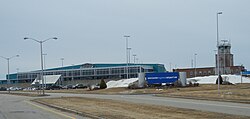
The 1980s and early 1990s were characterized by a mix of commuter and mainline services. Bar Harbor Airlines and Precision Airlines provided turboprop and piston aircraft shuttles. Later, major carriers such as Northwest Airlines, Continental, USAir, and Piedmont operated mainline jets. To accommodate this growth, the terminal was expanded with two ground-level jetways before eventually being replaced.
Commercial Volatility (2000–2020)
The turn of the millennium brought a series of short-lived commercial ventures. Pan American Airways operated Boeing 727-200s to Orlando from 2001 to 2004. Allegiant Air followed in 2005, but departed in 2006 due to high fuel costs. Direct Air attempted service from 2008 to 2012, utilizing a variety of aircraft through wet-lease agreements (leasing an aircraft complete with crew and maintenance) before filing for bankruptcy.
A significant milestone occurred on November 7, 2013, when JetBlue launched daily flights to Orlando and Fort Lauderdale, marking the return of mainline service after a decade. Initially using Embraer 190s, JetBlue eventually upgraded to 162-seat Airbus A320s to meet demand. JetBlue also expanded to New York JFK in 2018 following the installation of a new landing system.
Other attempts at expansion included American Airlines, which operated service to Philadelphia from 2018 to 2020, and Delta Connection, which launched service to Detroit in 2019. Additionally, Rectrix Aviation established a fixed-base operator (FBO)—a business granting aircraft parking and fueling services—and briefly ran a shuttle to Cape Cod in 2017.
Modern Recovery and Massport Ownership
The COVID-19 pandemic severely disrupted operations, leading JetBlue and American Airlines to suspend services. While Delta maintained minimum service through the CARES Act, the airport faced a period with no scheduled commercial flights in early 2021. However, a recovery began in late 2021 as JetBlue, Delta, and American Airlines announced returns. American Airlines shifted its focus from Philadelphia to New York-Kennedy to utilize larger Embraer 175 aircraft.
By 2023 and 2024, JetBlue resumed service to Orlando and introduced seasonal flights to Fort Myers, further increasing capacity with Airbus A320 aircraft.
Administratively, the airport transitioned from city control to the Massachusetts Port Authority (Massport). Following a period of shared deficit funding between 2004 and 2007, ownership was officially transferred to Massport on July 1, 2010.
| Period | Massport Deficit Contribution | Ownership Status |
|---|---|---|
| July 2004 – June 2005 | 100% (excluding debt service) | City of Worcester |
| July 2005 – June 2006 | 85% (excluding debt service) | City of Worcester |
| July 2006 – June 2007 | 68% (excluding debt service) | City of Worcester |
| July 1, 2010 – Present | N/A | Massport |
Key Facts
- First Airport: Opened in North Grafton on October 12, 1927, by Whitin Whitall.
- Current Site: Tatnuck Hill airport opened May 4, 1946.
- Major Carriers: Historically served by Northeast, Delta, JetBlue, and American Airlines.
- Ownership: Transferred to Massport on July 1, 2010.
- Pop Culture: Used as a filming location for Captain Phillips, Knight and Day, The Judge, and The Sea of Trees.
Frequently Asked Questions
Why was the airport moved from Grafton to Tatnuck Hill?
The Grafton airport was considered too small to meet the growing air travel needs of the region, leading the city to select the larger Tatnuck Hill site despite its tendency for fog.
Which airline currently provides the most capacity?
JetBlue has significantly increased its capacity by replacing Embraer 190 aircraft with larger 162-seat Airbus A320s for its routes to Florida.
What is a wet-lease agreement in the context of Direct Air?
A wet-lease is an arrangement where one airline hires an aircraft from another, including the crew, maintenance, and insurance. Direct Air used this to operate Boeing 737s from Xtra Airways and other chartered aircraft.
How did the COVID-19 pandemic affect the airport?
The pandemic led to the indefinite suspension of services by JetBlue and the total removal of Worcester from American Airlines' route map, leaving Delta as the sole operator for a period under the CARES Act.
Who owns and operates the airport today?
The Massachusetts Port Authority (Massport) became the official owner and operator of the airport on July 1, 2010.