
Wright-Patterson Air Force Base: A History of Aviation Innovation
From the early experimental flights of the Wright brothers to the high-stakes diplomacy of the Dayton Peace Accords, Wright-Patterson Air Force Base (WPAFB) has served as a cornerstone of American aerospace development. Located near Dayton, Ohio, the base is not merely a military installation but a living chronicle of how humanity conquered the skies and navigated the complexities of the Cold War.
Long before the roar of jet engines, the land held prehistoric significance, featuring Indian mounds of the Adena culture along P Street and at the Wright Brothers Memorial.
The Dawn of Flight and Early Military Roots
The base's legacy began between 1904 and 1905 at Huffman Prairie, an 84-acre plot where Wilbur and Orville Wright conducted experimental test flights with the Wright Flyer III. This site remained a hub for aviation through the Wright Company School of Aviation from 1910 to 1916.
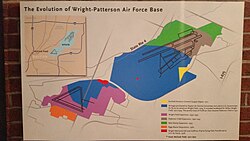
As World War I intensified, the U.S. Army expanded its footprint in the region. This included the lease of 2,075 acres along the Mad River, the purchase of 40 acres for the Fairfield Aviation General Supply Depot, and the establishment of McCook Field. By 1918, Wilbur Wright Field provided essential hangar space and mechanics to support aircraft assembly under Chief of Air Service Mason Patrick.
Post-War Consolidation and the Birth of Wright Field
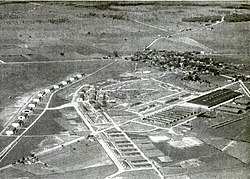
Following World War I, the Army began collecting technical artifacts, including 347 captured German aircraft. To centralize aviation engineering, the Patterson family's Dayton Air Service Committee raised $425,000 in just two days to purchase over 4,500 acres of land.
In 1924, these deeds were presented to President Calvin Coolidge. The resulting installation, designated Wright Field, became a premier center for aviation engineering. Between 1925 and 1927, new facilities were constructed to absorb the functions of the former McCook Field.
A Golden Era of Aeronautical Achievements
The interwar period saw Wright Field become a global leader in flight records and technical breakthroughs. Pilots pushed the boundaries of altitude, duration, and speed through a series of daring milestones:
- Altitude: Maj. R. W. Schroeder set an unofficial record of 28,899 ft in 1919, followed by an official two-man record of 31,821 ft in October 1919.
- Endurance: In April 1923, Lts. J. A. Macready and O. G. Kelly set non-refueled world records for duration (36:04:34) and distance (2,516.55 miles).
- Scale: The Barling bomber, the largest U.S.-made airplane of its time, took its initial flight at Wright Field in August 1923.
- Technology: By 1928, the base was testing liquid oxygen breathing systems and superchargers designed to maintain sea-level pressure at 30,000 ft.
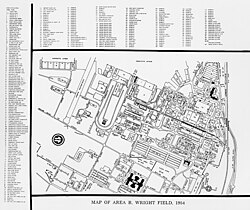
On October 12, 1927, Wright Field was formally dedicated. The ceremony featured Orville Wright raising the flag over the new engineering center and the John L. Mitchell Trophy Race, won by Lt. I. A. Woodring at 158.968 mph.
The Evolution of Patterson Field and World War II
On July 1, 1931, the eastern portion of the base was redesignated Patterson Field in honor of Lieutenant Frank Stuart Patterson, who was killed in a 1918 crash while testing a synchronized machine gun.
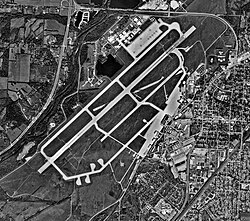
World War II triggered an unprecedented expansion. Employment surged from 3,700 in 1939 to over 50,000 at the war's peak. The facility grew to 2,064 acres with approximately 300 buildings and the Air Corps' first modern paved runways.
The base became a center for crash intelligence, reverse-engineering captured enemy technology. During the "Robot Blitz" of 1944, Wright Field successfully fired a reconstructed German pulse-jet engine. Operation Lusty brought 86 German aircraft, including the Me 262 jet fighter, for study, while Operation Paperclip brought German scientists to work in the base's laboratories.
Cold War Operations and UFO Investigations
In 1948, the installation was officially named Wright-Patterson Air Force Base. During the Cold War, it served as a critical hub for the Strategic Air Command (SAC), operating B-52 Stratofortresses and KC-135 Stratotankers through the 17th Bombardment Wing until 1975.
The base also became the center of public fascination due to its investigation of unidentified flying objects (UFOs). Starting in July 1947 with Project Sign (later Project Grudge and Project Blue Book), the base analyzed thousands of sightings. By 1969, the Foreign Technology Division had studied 12,618 reports; while 701 remained unexplained, the Air Force concluded there was no evidence of extraterrestrial origins.
The Space Race and Global Diplomacy
WPAFB played a quiet but vital role in the early Space Race. In February 1952, the Aerospace Medical Laboratory conducted final medical examinations for the Mercury astronauts, including future NASA legends Neil Armstrong and Ed White.
In November 1995, the base hosted the Dayton Peace Accords. Led by diplomat Richard Holbrooke, leaders from Bosnia and Herzegovina, Croatia, and Serbia negotiated an end to the Bosnian War, resulting in the creation of the Federation of Bosnia and Herzegovina and Republika Srpska.
Modern Era and Legacy
Today, the base continues to support global operations. In recent years, the 88th Medical Group and 445th Airlift Wing deployed personnel to Detroit and New York City to assist with the COVID-19 pandemic response. As of September 30, 2024, the permanent workforce consists of 7,139 military and 15,642 civilian personnel.
Adjacent to the base is the National Museum of the United States Air Force, the world's largest military aircraft museum. It preserves iconic aircraft such as the XB-70 Valkyrie, the F-117 Nighthawk, and the B-17 Memphis Belle.
Key Facts
- Founding Site: Huffman Prairie was used by the Wright brothers for test flights in 1904–1905.
- WWII Peak: Employment grew from 3,700 in 1939 to over 50,000 during the war.
- UFO Studies: Analyzed 12,618 sightings under Projects Sign, Grudge, and Blue Book.
- Diplomatic Milestone: Hosted the 1995 Dayton Peace Accords to end the Bosnian War.
- Space Connection: Conducted medical screenings for the original Mercury astronauts.
- Current Workforce: Over 22,000 combined military and civilian personnel (as of 2024).
| Period/Year | Event/Development | Significance |
|---|---|---|
| 1904–1905 | Huffman Prairie Flights | Experimental tests by Wilbur and Orville Wright |
| 1927 | Formal Dedication | Establishment of the new aviation engineering center |
| 1931 | Patterson Field Redesignation | Honored Lt. Frank Stuart Patterson |
| 1943–1945 | Operation Lusty/Paperclip | Study of captured German/Japanese aircraft and scientists |
| 1947–1969 | Project Blue Book | Official USAF investigation into UFO sightings |
| 1995 | Dayton Peace Accords | Negotiations to end the Bosnian War |
Frequently Asked Questions
Why is the base named Wright-Patterson?
The base honors both the Wright brothers, who conducted early flight experiments at Huffman Prairie, and Lieutenant Frank Stuart Patterson, a pilot who was killed in a 1918 crash while testing a synchronized machine gun.
What was the base's role in UFO research?
Through Projects Sign, Grudge, and Blue Book, the base's intelligence divisions investigated over 12,000 reported UFO sightings between 1947 and 1969, concluding that there was no evidence of extraterrestrial sources.
How did the base contribute to the US space program?
The Aerospace Medical Laboratory at WPAFB performed the final medical examinations for the selection of the Mercury astronauts, including Neil Armstrong and Ed White.
What are the Dayton Peace Accords?
These were negotiations held at WPAFB in 1995 between the presidents of Bosnia and Herzegovina, Croatia, and Serbia, which successfully ended the Bosnian War.
What can be seen at the National Museum of the US Air Force?
The museum houses the world's largest collection of military aircraft, including the only existing XB-70 Valkyrie, the F-117 Nighthawk stealth fighter, and the B-17 Memphis Belle.