
Wyck House: A Legacy of Quaker Heritage and Horticulture
Wyck stands as a testament to centuries of family continuity, blending the values of the Quaker faith with a passion for land, industry, and botany. From its origins with early European settlers to its current status as a preserved house museum, the estate reflects the evolving social and economic landscape of Pennsylvania.
The Early Foundations of the Estate
The history of Wyck begins with Hans Millan (also spelled Milan), a descendant of a Swiss Mennonite family and a Quaker who arrived from Germany by 1689. The property remained within the family through successive generations of marriage and professional success. Hans' daughter, Margaret, married Dirck Jansen, a Dutch Quaker who became a prosperous linen weaver in the early 18th century. By the end of his life, Jansen had Anglicized his name to Dirk Johnson and was recognized as a gentleman.
The family's wealth grew further when their daughter, Catherine, married Caspar Wistar. A German convert to Quakerism, Wistar amassed a significant fortune through diverse ventures, including land investment and the production of glass and buttons.
Expansion and Infrastructure
In the next generation, Margaret Wistar married Reuben Haines, a merchant and brewer from Burlington County, New Jersey. Reuben was a pivotal figure in regional development; in 1771, he funded the construction of the first road in what would become Centre County, running from Sunbury through the Woodward Narrows to the site of Spring Mill (now Pennsylvania Route 45).
The influence of the Haines family extended to local governance and geography. Before Centre County was officially declared in 1800, a large area known as Haines Township existed. This territory was later annexed to form portions of Gregg Township (1826) and Penn Township (1844).
The Evolution of the Wyck Home
The estate eventually passed to Caspar Wistar Haines and his wife, Hannah Marshall. It was later inherited by Reuben Haines III (1786–1831) and Jane (Bowne) Haines (1792–1843). While Wyck had previously served as a summer home, Reuben III transitioned it into the family's permanent residence.
To modernize the estate, Reuben III commissioned his friend, the architect William Strickland, to remodel the entire building. Interestingly, the name "Wyck" was the result of a historical misunderstanding. Reuben III encountered a landscape sketch of a property called "Wyck the Seat of Richard Haines esq." Assuming Richard Haines was a relative, Reuben adopted the name for his own home. Despite later discovering there was no familial connection to Richard Haines, the name remained.
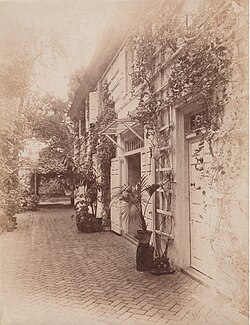
Following the deaths of Reuben III and Jane, the property passed to their youngest daughter, Jane Reuben Haines. She resided at Wyck until 1911, during which time she meticulously preserved the house, its furnishings, and the surrounding gardens.
Innovation and Education
The eighth generation of the family was marked by significant intellectual and technical contributions. Jane B. Haines founded the Pennsylvania School of Horticulture for Women (now known as Temple Ambler), the first institution of its kind. Her brothers were equally innovative: Caspar contributed to the design of the Mexican railway system, and Robert invented a specialized gauge for measuring steel in rolling mills.
The final private owners, Robert B. Haines and Mary (Troth) Haines, dedicated themselves to fruit growing. Robert developed and patented a device for pressing apples to produce a more natural-tasting juice.
Preservation and the Wyck Association
Following the death of Robert B. Haines in 1973, Mary Haines initiated the transfer of the estate and its private collections to ensure their survival. Since 1978, the site has been managed by the Wyck Association, which maintains the property as a house museum for the public.
Key Facts
- Original Owner: Hans Millan, a German Quaker/Swiss Mennonite descendant (by 1689).
- Architectural Remodel: Conducted by William Strickland for Reuben Haines III.
- Naming Origin: Named after a sketch of "Wyck the Seat of Richard Haines esq." despite no actual relation.
- Educational Legacy: Home to the founder of the Pennsylvania School of Horticulture for Women.
- Current Status: Operated as a house museum by the Wyck Association since 1978.
| Family Member | Key Contribution/Role | Period/Note |
|---|---|---|
| Hans Millan | Earliest Owner | By 1689 |
| Dirck Jansen (Johnson) | Linen Weaver | Early 18th Century |
| Caspar Wistar | Glassmaker and Investor | Wealth Accumulation |
| Reuben Haines | Road Construction | Funded PA Route 45 (1771) |
| Reuben Haines III | Estate Remodeling | Hired William Strickland |
| Jane B. Haines | Horticultural Education | Founded PA School of Horticulture for Women |
| Robert B. Haines | Agricultural Innovation | Patented apple press device |
Frequently Asked Questions
How did the house get the name "Wyck"?
Reuben Haines III saw a sketch of a property called "Wyck the Seat of Richard Haines esq." and, believing Richard was a relative, applied the name to his own home. It was later discovered that there was no family connection to Richard Haines.
Who was responsible for the architectural changes at Wyck?
Reuben Haines III hired his friend, the architect William Strickland, to remodel the entire building after moving his family into the house as a permanent residence.
What is the significance of Jane B. Haines to horticulture?
Jane B. Haines founded the Pennsylvania School of Horticulture for Women, which is the first school of its kind and is now known as Temple Ambler.
When did Wyck become a public museum?
After the death of Robert B. Haines in 1973, Mary Haines began the transfer of the property and collections. The Wyck Association has run the site as a house museum since 1978.
What role did the Haines family play in Pennsylvania's infrastructure?
Reuben Haines funded the first road in what is now Centre County in 1771, and the family's original land holdings (Haines Township) were later used to form parts of Penn and Gregg Townships.