
Xanten History: From Roman Colonia to Modern Leisure Town
Xanten, located in the Lower Rhine region of Germany, is a town where layers of history are physically visible. From its origins as a strategic Roman military outpost to its evolution into a medieval religious center and its eventual rebirth as a modern leisure destination, Xanten offers a profound look at the shifts in European power, faith, and urban development over four millennia.
The Roman Era: Military Might and Urbanism
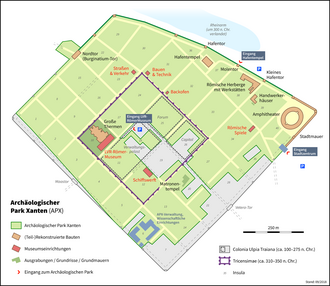
Human settlement in the region dates back to approximately 2000 BC, but the town's significance surged around 15 BC with the creation of Vetera, a Roman castrum (military camp) on the Fürstenberg. Serving as a launchpad for campaigns into Germania and the primary base for the Classis germanica (the Roman Rhine fleet), Vetera housed between 8,000 and 10,000 legionaries until its destruction during the Revolt of the Batavi in 70 AD.
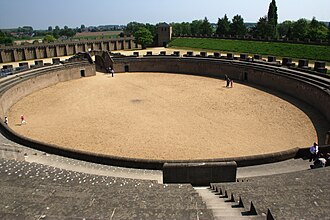
Following this, a second camp, Castra Vetera II, was established at Bislicher Insel, serving as the base for Legio VI Victrix. By 110 AD, Emperor Marcus Ulpius Traianus granted the nearby settlement the status of a colonia, renaming it Colonia Ulpia Traiana. This planned city featured a town wall and an amphitheatre, becoming the second most important commercial hub in the province of Germania Inferior, trailing only Colonia Agrippinensis (modern-day Cologne).
![Set of Roman silvered-bronze horse trappings from Xanten, now in the British Museum[4]](/images/3b/9f/3b9f29fc3fc1813355f82d67d37311540c91f4833bc3e481f3f08c55f524889d.jpg)
The city's fortunes shifted in 275 AD when Germanic tribes nearly destroyed the colonia. In 310 AD, a smaller, more defensible town called Tricensimae ("of the Thirtieth") was built upon the central nine insula (city blocks) of the former colony. However, increasing Germanic assaults led to the final abandonment of Tricensimae in the early 5th century.
The Legacy of Saint Viktor
Around 300 AD, Viktor of Xanten became a martyr after refusing to sacrifice to Roman gods as part of the Theban Legion. His veneration by both the Catholic and Eastern Orthodox Churches laid the spiritual foundation for the town, with his relics remaining in the high altar of Xanten Cathedral to this day.
The Middle Ages and the Rise of the Town
During the 5th century, the Franks settled in the area. Unlike the Romans, they did not build in stone, leaving behind only graves rather than urban structures. Local legend also links the area to the Nibelungs, claiming the mythical Siegfried of Xanten was born here.
By the late 8th century, a church was built on an ancient Roman cemetery and named Sanctos ("place of saints"), derived from the grave of Saint Viktor. This site evolved into the modern town center. Xanten's strategic and religious importance grew, leading the Archbishop of Cologne to grant the settlement town rights on July 15, 1228.
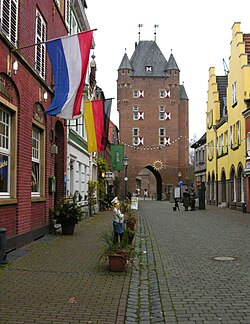
The town's architectural crowning achievement began in 1263 with the foundation of the Gothic St. Victor cathedral, which took 281 years to complete, finally finishing in 1544. However, the era was not without conflict; the town was divided between the Dukes of Cleves and the Archbishopric of Cologne until 1444, when the Duchy of Cleves gained full control.
Early Modern Challenges and Religious Shifts
The transition to the early modern period brought economic hardship. As the bed of the Rhine shifted away from the town, Xanten lost its status as a trading hub. The population plummeted from 5,000 in the early 16th century to roughly 2,500 by the end of the 18th century.
Despite economic decline, the borough of Marienbaum became a major pilgrimage site between 1430 and 1441. In the 17th century, the town came under the Margraviate of Brandenburg. The Treaty of Xanten (November 12, 1614) established legal equality between Protestantism and the Roman Catholic Church, though the population remained overwhelmingly Catholic for centuries.
The 19th Century to the World Wars
The 19th century saw the secularization of the Viktor-convent by Napoléon Bonaparte in 1802. While the town's economy struggled, archaeological interest in the ruins of Colonia Ulpia Traiana grew, leading to significant excavations between 1819 and 1844.
The late 1800s were marred by a high-profile case of blood libel. In 1891, the death of a child led to the wrongful arrest and trial of Adolf Buschoff, a Jewish butcher. Despite a lack of evidence and a jury's acquittal, the antisemitic agitation forced Buschoff to leave the town and significantly reduced the local Jewish population.
The Impact of Nazi Germany and WWII
The rise of the NSDAP in the 1930s brought systemic harassment of Xanten's Jewish residents, culminating in the destruction of their prayer room during Reichskristallnacht in 1938. During WWII, the town hosted a Luftwaffe ammunition factory at Die Hees, where forced laborers were subjected to brutal conditions.
In February 1945, Allied bombardments destroyed 85% of the town, including heavy damage to the cathedral. Canadian troops captured the town on March 8, 1945, after intense fighting against German paratroopers. The town was subsequently occupied by British troops.
Post-War Recovery and Modern Xanten
Reconstruction lasted until 1966, guided by archaeologist Walter Bader. The population grew significantly due to the resettlement of expellees from East Prussia. A 1969 reorganization integrated several surrounding localities, expanding the town's area from 8 km² to 72 km².
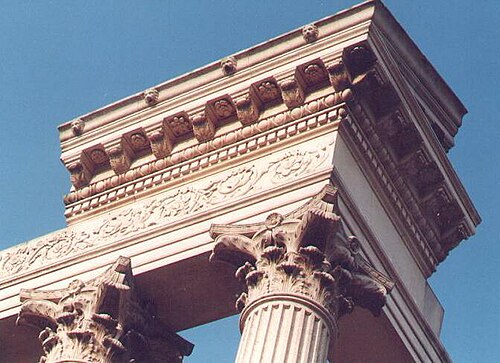
In 1975, the Archäologischer Park Xanten opened, providing a partial reconstruction of the Roman colony and establishing the town as a major tourist destination. In 1988, Xanten became the first town in the Düsseldorf region to be recognized as a state-recognized leisure town.
Key Facts
- Roman Origins: Home to the castrum Vetera and later the major colonia Colonia Ulpia Traiana.
- Religious Center: Centered around the relics of Saint Viktor and the Gothic St. Victor cathedral.
- Economic Shift: Transitioned from a Rhine trading hub to a leisure and tourism destination.
- WWII Destruction: Approximately 85% of the town was destroyed by 1945.
- Modern Attraction: The Archäologischer Park Xanten reconstructs the Roman urban landscape.
| Period | Key Entity/Event | Primary Characteristic |
|---|---|---|
| Antiquity | Colonia Ulpia Traiana | Roman military base and commercial hub |
| Middle Ages | St. Victor Cathedral | Religious pilgrimage and Gothic architecture |
| Early Modern | Treaty of Xanten (1614) | Religious coexistence and economic decline |
| 19th/20th Century | WWII / Reconstruction | Severe destruction followed by urban rebirth |
| Modern Era | Archäologischer Park Xanten | Tourism and state-recognized leisure town |
Frequently Asked Questions
What was Colonia Ulpia Traiana?
It was a Roman colony established around 110 AD by Emperor Marcus Ulpius Traianus. It served as a major commercial center in the province of Germania Inferior and featured a town wall and an amphitheatre.
Who was Viktor of Xanten?
Viktor was a member of the Theban Legion who was executed around 300 AD for refusing to sacrifice to Roman gods. He is venerated as a saint, and his relics are kept in Xanten Cathedral.
Why did Xanten's economy decline in the early modern period?
The town's economic downturn was primarily caused by the shifting bed of the Rhine river, which moved away from the town and stripped Xanten of its status as a vital trading port.
What happened to Xanten during World War II?
The town suffered devastating Allied bombardments and ground fighting, resulting in the destruction of 85% of its buildings. It was liberated by Canadian troops on March 8, 1945.
What is the Archäologischer Park Xanten?
Established in 1975, it is an archaeological park that features partial reconstructions of the Roman city of Colonia Ulpia Traiana for educational and tourism purposes.