
Young Communist International: The Rise and Fall of a Global Youth Movement
The history of the Young Communist International (YCI) is a narrative of ideological struggle, shifting loyalties, and the tension between local initiative and centralized control. Emerging from the wreckage of pre-war socialist alliances, the YCI sought to mobilize the youth of the world toward a revolutionary future, mirroring the broader splits and consolidations of the global communist movement during the early 20th century.
The Pre-War Era: The IVSJO
Before the First World War, efforts to unify socialist youth were fragmented. After unsuccessful attempts in 1889 and 1904, the International Union of Socialist Youth Organisations (Internationale Verbindung Sozialistischer Jugendorganisationen, or IVSJO) was finally established in May 1907 during a conference in Stuttgart, Germany. Headquartered in Vienna, the IVSJO served as the youth wing of the Second International.
The organization's early leadership included Hendrik de Man as the first International Secretary, followed by Robert Danneberg from 1908 to 1915. Its first Chairman was Karl Liebknecht, a German anti-militarist radical who became a pivotal figure and "elder statesman" for radical youth across Europe.
War, Rupture, and Reconstitution
The outbreak of World War I effectively dismantled the IVSJO. Because the organization was built on the principle of educational cooperation across all national socialist tendencies, the support of various national parties for their own governments during the conflict made international cooperation impossible.
However, a radical youth movement based in neutral Switzerland attempted to revive the spirit of internationalism. Led by the charismatic Willi Münzenberg, an anti-militaristic conference was convened in Bern on April 4, 1915. While the delegates did not endorse Vladimir Lenin's call for a revolutionary civil war, they did embrace revolutionary socialism and the need for a youth movement independent of chauvinistic national parties.
This Bern conference established the International Youth Bureau in Zurich and launched the publication Die Jugendinternationale (The Youth International), with Willi Münzenberg serving as the International Secretary of the reconstituted IVSJO.

The Formation of the YCI
By 1918, most European socialist youth organizations—excluding those in France, the Netherlands, and Germany—had joined the reconstituted IVSJO. Despite this unity, a deep ideological rift emerged between the pacifist Center, which advocated for armaments limitation and binding arbitration, and the revolutionary Left, which viewed international revolution as the only solution to capitalist warfare.
The definitive break occurred in March 1919 with the creation of the Communist International (Comintern) in Moscow. This forced young socialists to abandon neutrality and choose between electoral socialism and revolutionary communism.
On November 20, 1919, Willi Münzenberg convened a secret meeting in a Berlin beer hall. Delegates from 12 nations—including Russia, Germany, Italy, and Spain—assembled for what became the First Congress of the YCI. The conference officially changed the organization's name to the Young Communist International and established a five-member Executive Committee (ECCYI) based in Berlin.
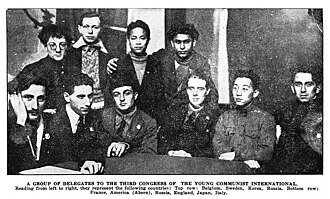
The Struggle for Autonomy vs. Centralization
A primary conflict in the YCI's early years was the relationship between youth organizations and their adult party counterparts. Russian delegate Lazar Shatskin argued that youth groups should be under the direct control of adult parties. Conversely, Western European delegates sought an independent vanguard role for the youth.
A compromise was reached: the YCI was defined not as a "sister" organization to the Comintern, but as a "part" of it. National youth groups were required to follow either the Comintern's program or that of the member party in their own country.
This tension peaked in 1921. Willi Münzenberg and the Berlin-based group feared that over-centralization would stifle "revolutionary initiative" and replace old social democratic bureaucracies with a new communist one. This led to a clash over the Second World Congress. The ECCYI independently scheduled the congress for April 6 in Jena (later moved to Berlin for security), defying the Russo-centric faction and Grigory Zinoviev, who wanted the meeting in Moscow.
The Berlin meeting was abruptly terminated by the Comintern. Subsequently, a "Real Second Congress" was held in Moscow from June 9 to June 23, 1921. Despite interventions by Lenin and Trotsky to reconcile divergent views, the result was the transfer of YCI headquarters to Moscow and the enforcement of centralized discipline. Following this, Münzenberg was moved to other work, and Voja Vujović succeeded him as head of the organization.
Key Facts
- Founded: The YCI was formally established during the First Congress in Berlin on November 20, 1919.
- Predecessor: The International Union of Socialist Youth Organisations (IVSJO), founded in 1907.
- Key Figures: Karl Liebknecht (early inspiration), Willi Münzenberg (International Secretary), and Voja Vujović (later head).
- Structural Shift: The organization moved from a Berlin-based center to Moscow-based centralization after 1921.
- Naming Convention: Member organizations were eventually required to use the name "Young Communist League" followed by their country.
- Dissolution: The YCI was dissolved in 1943 alongside the Comintern.
| Organization | Period | Primary Focus | Headquarters |
|---|---|---|---|
| IVSJO | 1907–1914 | Educational cooperation / Socialist youth | Vienna |
| Reconstituted IVSJO | 1915–1919 | Anti-militarism / Revolutionary socialism | Zurich |
| YCI | 1919–1943 | Revolutionary communism / Comintern alignment | Berlin, then Moscow |
| WFDY | Post-1943 | Successor organization | Various |
Frequently Asked Questions
What was the difference between the IVSJO and the YCI?
The IVSJO was an earlier, more broadly socialist and educational union focused on cooperation between various socialist tendencies. The YCI was a more disciplined, revolutionary organization specifically aligned with the Communist International (Comintern) and focused on international revolution.
Why did the YCI move its headquarters from Berlin to Moscow?
The move was the result of a power struggle between those favoring local revolutionary initiative (led by Willi Münzenberg in Berlin) and those favoring centralized control by the Comintern in Moscow. After the disputed 1921 congresses, Moscow's centralized discipline prevailed.
Who was Willi Münzenberg?
Willi Münzenberg was a charismatic leader of the Swiss socialist youth movement who played a leading role in reconstituting the IVSJO during WWI and served as the International Secretary during the formation of the YCI.
How did the YCI relate to the Comintern?
While there was initial debate over its independence, it was eventually decided that the YCI was not a sister organization but a "part" of the Comintern, meaning it was subject to the Comintern's political program and centralized discipline.
What happened to the YCI after 1943?
The YCI was dissolved in 1943 in conjunction with the dissolution of the Communist International. Its successor organization is the World Federation of Democratic Youth (WFDY).