
Yvette Clarke: Legislative Record and Policy Positions in the U.S. House
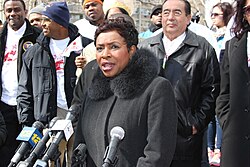
Yvette Clarke serves as a prominent member of the U.S. House of Representatives, representing a diverse district in Brooklyn, New York. Her tenure has been defined by a commitment to civil rights, technological oversight, and progressive social policy. From advocating for the marginalized to addressing the complexities of the digital age, Clarke has maintained a consistent legislative focus on equity and human rights.
Her district, which was redrawn from the 11th in 2013, encompasses several vibrant Brooklyn neighborhoods, including Sheepshead Bay, Gerritsen Beach, Brownsville, Crown Heights, East Flatbush, Flatbush, Kensington, Midwood, Prospect Heights, Prospect Lefferts Gardens, and Park Slope.
Key Facts
- District: Represents multiple Brooklyn neighborhoods, including Brownsville and Park Slope.
- Leadership: Chairs the Congressional Black Caucus, Congressional Caribbean Caucus, and Congressional Caucus on Multicultural Media.
- Tech Focus: Introduced the Algorithmic Accountability Act and the Deepfakes Accountability Act.
- Environmental Stance: Maintains 100% ratings from the Sierra Club and League of Conservation Voters.
- Immigration: Strong advocate for the DREAM Act and the abolition of ICE.
Legislative Tenure and Key Initiatives
Throughout her career, Clarke has introduced legislation targeting both national security and individual liberties. In 2009, she successfully passed legislation to improve the process for individuals to remove their names from the Transportation Security Administration (TSA) No Fly List—a database used to identify individuals posing a security threat.
Cybersecurity and Technology
Clarke has emerged as a leading voice on the intersection of law and technology. She introduced the International Cybercrime Reporting and Cooperation Act in 2010 and the Homeland Security Cybersecurity Boots-on-the-Ground Act in 2013, the latter of which aimed to improve the recruitment and training of the Department of Homeland Security (DHS) cybersecurity workforce.
More recently, she has focused on the ethics of artificial intelligence. She co-introduced the Algorithmic Accountability Act of 2019 to empower the Federal Trade Commission (FTC) to study biases in technology. Additionally, she has introduced versions of the Deepfakes Accountability Act in both the 116th and 118th Congresses to protect national security and provide legal recourse for victims of harmful synthetic media.
Civil Rights and Preservation
Clarke has consistently championed the preservation of historical sites that highlight human rights struggles. She supported the Prison Ship Martyrs' Monument Preservation Act to study making the Fort Greene Park monument a unit of the National Park System, citing the need to remember the atrocities committed during the Revolutionary War.
Policy Positions
Social and Economic Policy
Clarke is pro-choice, earning high ratings from Planned Parenthood and NARAL Pro-Choice America for opposing restrictions on abortion rights. Economically, she aligns with progressive values, consistently opposing cuts to government spending and tax reductions for high earners. This stance earned her a 92% liberal rating from the National Journal in 2011.
Environment and Immigration
An advocate for climate action, Clarke supports limiting fossil fuel consumption and has been critical of the U.S. withdrawal from the Paris Agreement. On immigration, she supports a path to citizenship for undocumented immigrants and has praised the DACA program. In January 2026, she co-introduced the Melt ICE Act to end DHS funding for the detention and monitoring of immigrants.
Foreign Policy
Clarke supports a two-state solution to the Israeli-Palestinian conflict. While she has faced criticism from some constituents regarding her past petitions concerning the Gaza blockade, she voted to support Israel following the October 7 attacks. Additionally, she supported the JCPOA (Iran nuclear deal) to prevent nuclear proliferation and voted in 2023 to remove U.S. troops from Syria.
Committee and Caucus Leadership
Clarke holds significant influence through her committee assignments and leadership roles within various caucuses. For the 119th Congress, she serves on the Committee on Energy and Commerce, where she is the Ranking Member of the Subcommittee on Oversight and Investigations.
| Category | Role/Assignment |
|---|---|
| Committee | Energy and Commerce (Ranking Member, Oversight and Investigations) |
| Chairmanships | Congressional Black Caucus, Caribbean Caucus, Multicultural Media Caucus |
| Co-Chairmanships | Black Women and Girls, Black Men and Boys, Creator Economy Caucus |
| Memberships | Progressive Caucus, Medicare for All Caucus, Equality Caucus |
Frequently Asked Questions
What is the Deepfakes Accountability Act?
Introduced by Yvette Clarke, this legislation aims to protect national security from the threats posed by deepfake technology while providing legal remedies for individuals harmed by such synthetic media.
What is Clarke's position on immigration?
Clarke advocates for comprehensive immigration reform that includes a path to citizenship for undocumented immigrants, the abolition of ICE, and the protection of refugees, such as those from Haiti.
Which Brooklyn neighborhoods does Yvette Clarke represent?
Her district includes Sheepshead Bay, Gerritsen Beach, Brownsville, Crown Heights, East Flatbush, Flatbush, Kensington, Midwood, Prospect Heights, Prospect Lefferts Gardens, and Park Slope.
How has Clarke approached the issue of algorithmic bias?
Through the Algorithmic Accountability Act of 2019, she sought to grant the FTC more power to ensure that race, gender, and other biases do not unfairly influence technological systems.
What are her views on the Israeli-Palestinian conflict?
Clarke supports a two-state solution and has balanced this with votes to provide support to Israel during times of crisis, such as after the October 7 attacks.