
Zellij Tilework: The History and Art of Islamic Mosaic Tiles
Zellij is the intricate art of hand-cut terracotta tilework that has defined the architectural landscape of the western Islamic world for centuries. Characterized by complex geometric patterns and vibrant colors, this mosaic technique transforms walls, floors, and minarets into mathematical masterpieces. From its early origins in North Africa to its enduring presence in modern Moroccan identity, zellij represents a sophisticated fusion of art, geometry, and craftsmanship.
Key Facts
- Origins: Likely derived from Byzantine mosaics and developed in Ifriqiya (modern Tunisia) between the 10th and 11th centuries.
- Technique: Involves assembling small, hand-cut glazed tile pieces to create complex geometric or floral patterns.
- Regional Hubs: Historically flourished under the Marinid, Zayyanid, and Nasrid dynasties in Morocco, Algeria, and al-Andalus (Spain).
- Specialized Methods: Includes sgraffito (scratched relief) and cuenca/arista (molded ridges) for different decorative effects.
- Modern Status: Remains a vital part of Moroccan cultural identity, with Fez serving as the primary center of production.
Origins and Early Development (10th–13th Centuries)
The roots of zellij are believed to lie in the adaptation of Byzantine mosaic techniques by Muslim craftsmen using faience (tin-glazed pottery). Evidence from al-Mansuriyya and Mahdia in Tunisia suggests the technique emerged in Ifriqiya around the 10th or 11th century before spreading westward.
By the 11th century, the art had reached a high level of sophistication. In the Hammadid capital of Qal'at Bani Hammad (Algeria), archaeologists have found elaborate pavements featuring eight-pointed stars and cross-shaped lustre-painted tiles. These early works likely benefited from the migration of Ifriqiyan craftsmen fleeing invasions to the east.
![Mosaic tiling from the Qal'at Bani Hammad (present-day Algeria), 11th century[13]](/images/c6/5b/c65b6047fb68dcb2333197c43ce5e45c43ae46ad3ec58d9fbe15551c837a73db.jpg)
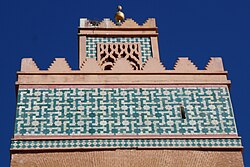
During the Almohad period, zellij became a prominent feature of religious architecture. The minarets of the Kutubiyya and Kasbah Mosques in Marrakesh utilized large green and white tiles. These early Moroccan examples were designed for visibility from a distance; each tile was pierced with a hole to be nailed to a wooden frame set in mortar.
Regional Generalization and Artistic Peak (14th–15th Centuries)
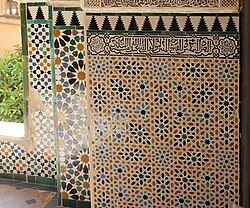
The 14th century marked a golden age for zellij, as the Marinid, Zayyanid, and Nasrid dynasties fostered a shared cultural aesthetic across Morocco, Algeria, and al-Andalus. While zellij fell out of favor in Tunisia—replaced by marble and stone—it became ubiquitous in the west, covering floors, lower walls (dadoes), and entrance portals.
Craftsmen expanded their palette to include iron-oxide yellows, deep blues, and manganese browns. This era produced some of the most famous examples of the craft, including the Alhambra palaces in Spain and the Marinid madrasas in Fez and Meknes. In some cases, the precision was staggering; some tile pieces in the Alhambra's Mirador de Lindaraja measure only 2 millimeters in width.
Regional Variations and Techniques
While geometric motifs dominated, the craftsmen of Tlemcen developed a distinct style featuring bright colors and floral palmettes. This influence extended to the Marinid madrasa of Chellah, suggesting the movement of specialized workshops across borders.
![Zellij remains in Chellah (14th century), in bright colours and floral motifs that may have been a hallmark of craftsmen from Tlemcen[3]: 206](/images/1f/af/1faf1950a914b96c6b73186756193ec47dcb6f2355560743a7530b53e62e90cf.jpg)
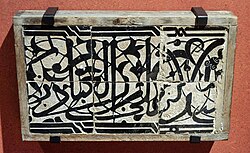
Another critical development was the sgraffito technique used for epigraphic friezes (decorative bands of writing). In this process, a black glaze was applied to square panels and then chipped away to leave the Arabic inscription in relief against a bare or white background.
Evolution and Later History (16th Century Onward)
As political landscapes shifted, so did the techniques of tilemaking. In Algeria, Ottoman rule led to the adoption of European square tiles from Italy and Spain. In Tunisia, the 18th century saw the rise of Qallaline tiles—painted square panels similar to Italian maiolica rather than the traditional mosaic style.
In Spain, the high demand for the Mudéjar style led to the invention of cuenca ("hollow") or arista ("ridge") tiles. Instead of hand-cutting each piece, craftsmen used molds to create ridges that prevented different colored glazes from bleeding during baking, allowing for mass production.
![Example of cuenca or arista tiles with Islamic geometric motifs, produced in 16th-century Spain, at the Metropolitan Museum of Art[26]](/images/01/fa/01facefbd0ea2f0cc1725431ad7d36b936dfca358f7b6297a047803c3c7d7a18.jpg)
The Moroccan Legacy
Unlike other regions, Morocco preserved and expanded the traditional zellij craft. Under the Saadi dynasty, the art became even more ubiquitous. In the Saadian Tombs, craftsmen reversed traditional coloring schemes, using colored linear strapwork against white backgrounds and employing thinner pieces for finer detail.
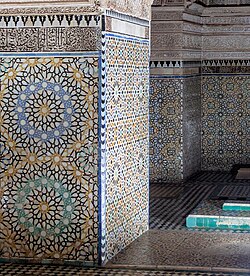
By the 19th and 20th centuries, the style evolved toward large-scale geometric rosettes and a broader color palette including red and bright yellow. This era saw zellij applied to a wider variety of surfaces, from the monumental gates of Meknes to cylindrical pillars in modern mansions.
![Example of a large-scale geometric rosette composition from later periods in Morocco, covering a fountain built in 1913 at Place el-Hedim in Meknes[30]](/images/58/22/5822978c1999234749f791f6ada6074e8d81d35acf79fcd06f6d6d83ddf2dc61.jpg)
Summary of Zellij Styles and Techniques
| Technique | Method | Key Characteristics | Primary Region/Period |
|---|---|---|---|
| Traditional Zellij | Hand-cut mosaic pieces | Complex geometry, high precision | Morocco, Al-Andalus (11th C–Present) |
| Sgraffito | Scratched glaze relief | Epigraphic friezes, black/green relief | Marinid Morocco (14th C) |
| Cuenca/Arista | Molded ridges | Mass-produced, prevents glaze bleeding | Spain (15th–17th C) |
| Qallaline | Painted square panels | Floral scenes, maiolica-style | Tunisia (18th C) |
Frequently Asked Questions
What is the difference between zellij and standard tiling?
Unlike standard tiles which are produced as pre-made squares or rectangles, zellij is a mosaic art. Large glazed tiles are hand-cut into small, precise geometric shapes which are then assembled like a puzzle to create complex patterns.
Where did zellij originate?
It is believed to have originated in Ifriqiya (modern-day Tunisia) between the 10th and 11th centuries, likely inspired by Byzantine mosaics, before spreading to Algeria and Morocco.
What is the sgraffito technique in tilework?
Sgraffito is a method where a colored glaze (often black or green) is applied to a tile and then partially scratched or chipped away to create a motif or inscription in relief.
Is zellij still produced today?
Yes, zellij remains a hallmark of Moroccan artistic identity. Fez continues to be the most important center of production, though other cities like Meknes and Marrakesh also produce it.
How did Spanish tilework evolve from zellij?
To meet high demand, Spanish craftsmen developed the cuenca or arista technique, using molds to create ridges on the tile. This allowed for faster production than the labor-intensive hand-cutting required for traditional zellij.