
Zhou Dynasty Inscriptions: The Evolution of Early Chinese Writing
The transition of Chinese writing during the Zhou dynasty represents a pivotal era in paleography. Moving from the highly pictographic styles of the Shang dynasty toward the structured systems of the imperial era, the inscriptions of the Zhou period reveal a gradual shift in how information was recorded, stylized, and standardized across a fragmented political landscape.
The Western Zhou Period
Writing in the Western Zhou dynasty was a direct continuation of the Shang system. Early bronze inscriptions from this era show no sudden break from their predecessors; they often feature irregular shapes and sizes, with structures that vary significantly between different pieces of writing or even within a single text.
While these early forms were not primarily pictographs in function, they retained a pictographic flavor—a visual quality that resembled the objects they represented. Over time, a process known as linearization began. This involved transforming rounded elements into squared ones, replacing solid shapes with short line segments, and shifting from variable-width lines to thin, uniform strokes.
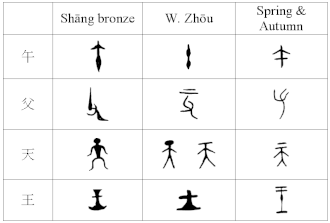
As the dynasty progressed, the flexibility of graph orientation (such as rotation and reversibility) became less common. By the reign of King Kāng (the third sovereign) and more prominently after King Yì (the ninth sovereign), the characters began to exhibit greater uniformity in size, structure, and arrangement.
The "Large Seal" Controversy
Some historians use the term large seal (dàzhuàn) to describe this script. However, this term originated during the Han dynasty to distinguish earlier scripts from the then-current small seal and clerical scripts. Because "large seal" is used inconsistently to describe various forms—including the 800 BC Shizhoupian compendium, late Western Zhou bronzes, and the Stone Drums of Qin—modern scholars often avoid the term to prevent confusion.
The Eastern Zhou: Spring and Autumn Period
By the start of the Eastern Zhou, specifically the Spring and Autumn period, the process of linearization was largely complete. Curved lines were straightened and disconnected elements were joined, making the script more convenient to write but further reducing its pictographic quality.
Initially, the various Chinese states maintained the late Western Zhou forms. However, regional styles soon began to diverge. The state of Qin remained the most conservative, adhering closely to older forms. During this time, bronze seals and minted coins entered use, though few seals from this specific period have been indisputably dated.
Artistic and Decorative Scripts
The mid to late Spring and Autumn period saw the rise of derivative, artistic scripts. In the eastern and southern states, vertically elongated forms appeared on bronzes. This evolved into highly decorative styles known as Bird Script (niǎoshū) and Worm Script (chóngshū), collectively called Bird-worm scripts (niǎochóngshū). These were used for ornamentation on bronze items rather than daily communication.
Alongside these formal styles, a "vulgar" or popular writing existed. This was often incised roughly and casually into bronzes, reflecting the everyday script used by the general population.
The Warring States Period
The Warring States period provided a wealth of new materials for study, including bronze coins, seals, and the first surviving manuscripts written on bamboo and silk.
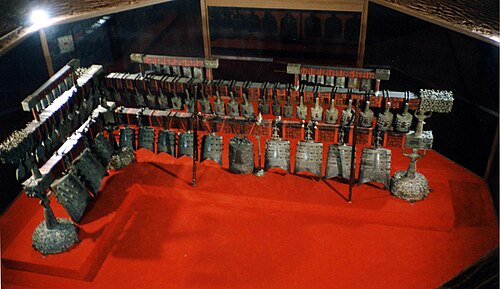
Early in this period, bronze inscriptions remained similar in length and content to those of the Spring and Autumn period. A primary example is the set of biānzhōng bells from the tomb of Marquis Yĭ of Zēng, discovered in 1978, which contains nearly 2,800 characters.
By the mid to late Warring States period, the nature of these inscriptions changed. They became shorter, often recording only the maker and date—particularly on weapons—and were typically engraved into already cast bronze rather than being molded into wet clay. This resulted in a rougher, more hurried execution.
Regional Divergence and the Rise of Clerical Script
The lack of central political control and the spread of literacy beyond the nobility accelerated the divergence of regional scripts. In the state of Qin, the script remained symmetrical and structurally conservative, evolving slowly into what is now called small seal script. Contrary to popular belief, small seal script was not a sudden invention by Li Si, but a gradual evolution.
Simultaneously, Qin's popular writing evolved into proto-clerical script, which eventually became the standard clerical script of the Han through Wei-Jin periods. In the eastern states, vulgar forms displaced traditional scripts more rapidly. These eastern variations were later labeled gǔwén ("ancient script") by the Han scholar Xu Shen, who mistakenly believed they predated the Qin forms.
Key Facts
- Linearization: The process of converting rounded, thick, pictographic elements into thin, uniform, squared line segments.
- Bird-Worm Script: Highly decorative, non-daily scripts used primarily for artistic bronze inscriptions.
- Qin Conservatism: The state of Qin maintained traditional script forms longer than eastern states, leading to the gradual development of small seal script.
- Material Shift: Later Warring States inscriptions shifted from piece-mold casting to engraving on finished bronze.
- Marquis Yĭ of Zēng: His tomb yielded biānzhōng bells with nearly 2,800 characters, one of the most significant early Warring States finds.
| Period | Primary Characteristics | Key Script Developments |
|---|---|---|
| Western Zhou | Irregular shapes, pictographic flavor | Beginning of linearization; gradual uniformity |
| Spring and Autumn | Full linearization, straightened lines | Regional divergence; Bird-Worm decorative scripts |
| Warring States | Shorter texts, engraved (not cast) | Evolution of Small Seal and Proto-Clerical scripts |
Frequently Asked Questions
What is linearization in the context of Chinese characters?
Linearization is the evolutionary process where rounded, pictographic elements of a character are transformed into squared shapes and thin, uniform line segments, making the characters less like pictures and more like abstract symbols.
Were Bird and Worm scripts used for daily writing?
No. Bird Script and Worm Script were primarily decorative forms used for artistic inscriptions on bronze items and were not used for everyday communication.
Did Li Si invent the small seal script?
No. While often believed to be a sudden invention by Li Si during the Qin dynasty, small seal script actually evolved gradually from the traditional forms used in the state of Qin during the Eastern Zhou.
How did the method of inscribing bronze change over time?
Early inscriptions were written into the wet clay of piece-molds before casting. By the mid to late Warring States period, inscriptions were typically engraved directly into the bronze after it had already been cast.
What is the difference between traditional and vulgar writing?
Traditional writing was the formal script used by the nobility and for official records, while vulgar (or popular) writing was a more casual, simplified version used in daily life, which eventually evolved into clerical script.