
Zond Probe Design: The 1963-1965 Original Configuration
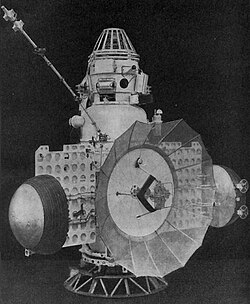
Between 1963 and 1965, the original design of the Zond probe established a sophisticated framework for interplanetary exploration. The spacecraft was engineered as a modular stack, measuring 3.6 meters in height and weighing approximately 1,000 kg. Its architecture was divided into three primary functional sections: the Orbital Compartment, the Planetary Compartment, and the propulsion system.
The Orbital Compartment
The core of the spacecraft was the Orbital Compartment, a pressurized hub that served as the brain of the probe. This section housed critical systems, including control electronics, radio transmitters and receivers, batteries, and astro-orientation equipment. To ensure the reliability of these systems, the compartment was pressurized to roughly 100 kPa and thermally controlled to simulate Earth-like conditions. This design choice allowed engineers to use standard electronic components rather than specialized hardware capable of withstanding extreme space environments.
The importance of this pressurization was highlighted during the Zond 1 mission, where the module depressurized during flight, resulting in severe damage to the probe's internal systems.
External to the compartment were several vital components:
- Solar Panels: Two panels provided electrical power. These remained folded against the probe's body during launch and deployed only once the craft reached its interplanetary trajectory.
- Radiators: Hemispherical radiators located at the ends of the solar panels used a coolant loop to expel excess heat from the Orbital Compartment into the vacuum of space.
- Communications: A 2-meter parabolic high-gain antenna enabled long-range communication, while additional antennas were utilized depending on the specific mission requirements, such as communicating with surface probes.
The Planetary Compartment
Positioned below the Orbital Compartment was the Planetary Compartment. This second pressurized section was versatile and varied based on the mission's objective. In some configurations, it served as a platform for scientific equipment dedicated to the orbital observation of a planet. In other missions, it was designed as a detachable module capable of descending to land on the planet's surface.
Propulsion and Attitude Control
To manage its path through space, the probe utilized a KDU-414 engine mounted at the top of the Orbital Compartment. This engine provided a maximum thrust of approximately 2 kN, utilizing a propellant combination of UDMH (unsymmetrical dimethylhydrazine) and nitric acid for course corrections.
While the KDU-414 handled major trajectory changes, the spacecraft's attitude control—the ability to adjust its orientation in space—was managed by a series of small cold gas thrusters.
Key Facts
- Total Height: 3.6 meters.
- Total Mass: Approximately 1,000 kg.
- Internal Pressure: 100 kPa (Orbital Compartment).
- Main Engine: KDU-414 with 2 kN maximum thrust.
- Propellants: UDMH and nitric acid.
- Power Source: Two deployable solar panels.
| Component | Feature | Specification/Detail |
|---|---|---|
| Dimensions | Height | 3.6 m |
| Mass | Total Weight | ~1,000 kg |
| Orbital Compartment | Pressure | 100 kPa |
| Propulsion | Engine Model | KDU-414 |
| Propulsion | Max Thrust | 2 kN |
| Communications | High-Gain Antenna | 2 m parabolic |
Frequently Asked Questions
What was the purpose of the Orbital Compartment's pressurization?
The compartment was pressurized to 100 kPa and thermally controlled to simulate Earth-like conditions. This allowed the use of standard electronic components instead of specialized, expensive hardware designed for extreme space conditions.
How did the Zond probe manage heat?
The probe used a coolant loop that transferred excess heat from the Orbital Compartment to hemispherical radiators located at the ends of the solar panels, which then radiated the heat into space.
What happened to Zond 1?
The Orbital Compartment of Zond 1 depressurized during flight, which caused severe damage to the probe's internal systems.
What were the two possible roles of the Planetary Compartment?
Depending on the mission, the Planetary Compartment either housed scientific instruments for observing a planet from orbit or functioned as a lander designed to detach and reach the planet's surface.
What propellants did the KDU-414 engine use?
The KDU-414 engine used a combination of UDMH (unsymmetrical dimethylhydrazine) and nitric acid to provide course correction thrust.