
Bay Shore History: From Colonial Settlement to Modern Waterfront Hub
Bay Shore stands as one of the oldest and most storied hamlets on Long Island. From its early days as a colonial outpost to its evolution into a premier resort destination and its subsequent modern revitalization, the community has mirrored the broader shifts of New York's regional development. Its journey is marked by a series of name changes, architectural milestones, and a resilient spirit of restoration.
Colonial Foundations and Early Settlement
The roots of the area stretch back to the late 17th century. Sagtikos Manor, located in West Bay Shore and built around 1697, serves as a primary historical anchor. During the Revolutionary War, this estate functioned as a headquarters for the British armed forces during the Battle of Long Island. Its significance continued into the early republic when President George Washington stayed at the manor during his 1790 tour of Long Island.
The land that eventually became the heart of Bay Shore was acquired in 1708. John Mowbray, a local school teacher, purchased the territory from the Secatogue (the indigenous Native American people of the region) in exchange for several eel spears.
The Evolution of a Name
The identity of the hamlet shifted frequently during its first 150 years. Early European settlers initially used the Secatogue names Penataquit and Awixa. In the early 19th century, the area was inexplicably renamed Sodom. This was followed by a brief period as Mechanicsville starting in 1842, before returning to Penataquit in 1849 to align with the local post office.
Because Penataquit was considered difficult to spell, the community finally adopted the name Bay Shore in 1868, a title that reflected its geographic appeal.
Growth in the 19th and Early 20th Centuries
By 1840, Bay Shore was a burgeoning center of faith and community, housing one of only two churches in the entire Town of Islip (a Methodist church built in 1828). By 1850, it was one of only two established hamlets in the town, alongside Sayville.
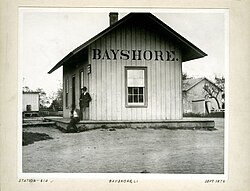
The late 19th century saw Bay Shore transform into a renowned destination for shopping and leisure. Affluent New Yorkers utilized the newly constructed Long Island Rail Road to escape the city for the white sand beaches of the Great South Bay and the fishing villages of Fire Island. This era established the hamlet as a premier summer and weekend tourist spot.
As the 20th century progressed, the area took on strategic importance. During World War I, Bay Shore served as the headquarters for the First Yale Unit, a United States Naval Air Reserve unit.
Post-War Expansion and Economic Shift
Following World War II, Bay Shore experienced a population surge. Between the mid-1950s and mid-1960s, former farms and woodlands were converted into housing developments. These homes were primarily occupied by working and middle-class first-time buyers relocating from New York City. Despite the rapid growth, Main Street remained a thriving regional shopping destination.
However, the late 1970s and 1980s brought a period of decline. The lack of a local government meant that critical decisions were handled by the Town of Islip and Suffolk County. Economic challenges were exacerbated by several factors:
- Rezoning: The shift from single-family housing to rental properties and multi-family dwellings altered the community's demographics.
- Competition: The construction of the South Shore Mall, located two miles north of Main Street, diverted customers away from local small businesses.
- Deinstitutionalization: Patients from the nearby Pilgrim State Hospital were relocated to downtown rental housing, often without the necessary professional support systems.
Modern Restoration and Revitalization
Since the 1980s, Bay Shore has undergone a comprehensive restoration. Old estates have been replaced by upscale gated communities featuring townhouses and condominiums. The community has also repurposed historic structures, such as converting the former Bay Shore Theater and opera house into a YMCA.
Main Street has seen a significant revival through the installation of antique-style streetlights, new sidewalks, and restored parks. In 2007, the Bay Shore Beautification Society created a recognized meditation garden from a previously empty lot. The commercial landscape has also shifted; the Gardiner Manor Mall's abandoned department stores were razed to make room for new retail spaces, including Target, Lowe's, and a BMW dealership.
Waterfront improvements have also been a priority. While a planned US battleship was deemed too large for the shallow waters of the Bay Shore Marina, a decommissioned WWII torpedo was installed as a monument. Additionally, Benjamin Beach received a new water park and renovated bath house in 2010. Near the train station, dilapidated housing was replaced by new condominiums in 2008 and 2009, complemented by a new pedestrian bridge over the tracks.
Key Facts
- Founded: Land purchased in 1708 from the Secatogue Native Americans.
- Historic Site: Sagtikos Manor (c. 1697) hosted George Washington in 1790.
- Name Changes: Previously known as Penataquit, Awixa, Sodom, and Mechanicsville.
- Transport: The Long Island Rail Road was pivotal in establishing the area as a tourist resort.
- Military History: Served as the WWI headquarters for the First Yale Unit.
| Era | Key Characteristics | Major Developments |
|---|---|---|
| Colonial (1697–1790s) | Early settlement and military use | Sagtikos Manor construction; Washington's visit |
| 19th Century | Identity shifts and tourism growth | LIRR access; name change to Bay Shore (1868) |
| Post-WWII (1950s–60s) | Rapid residential expansion | Conversion of farms to middle-class housing |
| Late 20th Century | Economic decline | South Shore Mall opening; Main Street vacancies |
| Modern Era (1980s–Present) | Urban renewal and revitalization | Main Street redevelopment; Marina upgrades |
Frequently Asked Questions
How did Bay Shore get its name?
The hamlet went through several names, including Penataquit, Awixa, Sodom, and Mechanicsville. It was officially renamed Bay Shore in 1868 because the previous name, Penataquit, was considered too difficult to spell.
What is the significance of Sagtikos Manor?
Built around 1697, Sagtikos Manor served as a British armed forces headquarters during the Revolutionary War's Battle of Long Island and was visited by President George Washington in 1790.
Why did Bay Shore decline in the late 1970s?
The decline was caused by a lack of local government, rezoning that shifted demographics, the opening of the South Shore Mall which hurt Main Street businesses, and the unsupported relocation of psychiatric patients from Pilgrim State Hospital.
What recent improvements have been made to the waterfront?
Improvements include the rebuilding of the marina's bulkhead and dock structures, the installation of a WWII torpedo monument, and the 2010 construction of a water park and renovated bath house at Benjamin Beach.
How has the train station area changed recently?
In 2008 and 2009, dilapidated housing near the station was replaced by new condominiums, and a pedestrian bridge was constructed to replace the old tunnel between platforms.