
Bell System History: The Rise and Fall of a Telecommunications Giant
The story of the Bell System is the story of modern communication. From a single patent in the late 19th century to becoming the largest corporation in the world, the Bell System defined how the United States—and eventually the globe—connected. Often referred to by the affectionate nickname "Ma Bell," this massive enterprise integrated research, manufacturing, and service into a single, seamless vertical monopoly.
The Foundations of the Bell System
The journey began on March 7, 1876, when Alexander Graham Bell received the U.S. patent for the invention of the telephone. In 1877, he formed the Bell Telephone Company, which established the first telephone exchange in New Haven, Connecticut. This sparked a rapid expansion, with local exchange companies appearing in every major American city within a few years.
By 1885, the organization evolved into American Telephone & Telegraph (AT&T). Originally created by the American Bell Telephone Company to facilitate long-distance calls between New York and Chicago, AT&T eventually became the parent company of American Bell in 1899. This shift occurred primarily because New York's regulatory and tax environment was more favorable than that of Boston, where American Bell was headquartered.

The Era of Competition and Consolidation
The industry faced a major turning point in 1894 when Bell's original patent expired. This opened the floodgates for competition, leading to the creation of 6,000 new telephone companies and causing a financial downturn for the Bell Telephone company.
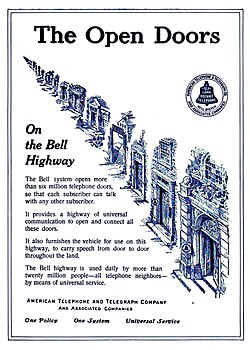
The tide turned on April 30, 1907, when Theodore Newton Vail returned as President of AT&T. Vail championed the philosophy of "One Policy, One System, Universal Service," believing that a single national system was superior to a fragmented market. Under his leadership, AT&T began aggressively acquiring smaller competitors, including the Western Union Telegraph Company.
The Architecture of a Monopoly
At its peak, the Bell System was organized into five primary divisions that allowed it to control every aspect of the telecommunications lifecycle:
- AT&T: The lead entity responsible for overall planning and finance.
- AT&T Long Lines: Managed long-distance calling, international lines, and submarine cables.
- Western Electric Company: The manufacturing arm that produced all necessary equipment.
- Bell Labs: The research and development hub, initially co-owned by AT&T and Western Electric.
- Bell Operating Companies (BOCs): The regional entities providing local exchange services.

This vertical monopoly meant that by 1940, the Bell System controlled everything from the wires in the ground to the handset on the desk. This dominance allowed the company to prohibit customers from connecting any equipment not sold by Bell without paying significant fees. Customers wanting a different style of phone had to purchase the device at cost, pay for rewiring, and pay a monthly lease fee to the company.
Legal Challenges and the Kingsbury Commitment
The federal government grew wary of AT&T's growing power. In 1913, an antitrust suit led to the Kingsbury Commitment, an out-of-court agreement with the Department of Justice. To avoid being broken up or nationalized, AT&T agreed to:
- Divest its $30 million in Western Union capital stock.
- Allow non-competing independent telephone companies to interconnect with its long-distance network.
- Seek permission from the Interstate Commerce Commission before acquiring other independent companies.
Following this agreement, the Federal Communications Commission (FCC) took over the regulation of AT&T in 1934.
The 1956 Consent Decree and Global Reach
By 1949, the Department of Justice again alleged that the Bell System was using its monopoly to gain unfair advantages in new technologies. This resulted in the 1956 consent decree, which limited AT&T to 85% of the U.S. national telephone network and forced it to divest interests in Canada and the Caribbean.
One of the most significant outcomes of this decree was the requirement for Bell to make its patents royalty-free. This move catalyzed innovation in the electronics and computer sectors and is cited as a foundational influence on the open-source movement.

Despite these restrictions, the Bell System remained a global powerhouse, holding a 54% stake in Japan's NEC and maintaining a reconstruction relationship with Nippon Telegraph and Telephone (NTT) after World War II.
The End of an Era: The 1984 Divestiture
The Bell System finally ceased to exist in 1984. This was the result of a 1974 antitrust lawsuit alleging that the company had illegally stifled competition. A settlement reached on January 8, 1982, led to the dismantling of the system, ending the era of "Ma Bell" and opening the telecommunications industry to the competitive landscape we recognize today.
Key Facts
- Founder: Alexander Graham Bell (patent granted March 7, 1876).
- Core Philosophy: "One Policy, One System, Universal Service."
- Key Divisions: AT&T, Long Lines, Western Electric, Bell Labs, and Bell Operating Companies.
- Major Legal Milestones: Kingsbury Commitment (1913), Consent Decree (1956), and Divestiture (1984).
- Global Impact: Forced royalty-free patents in 1956, accelerating computer and electronic innovation.
| Period/Event | Key Outcome | Impact |
|---|---|---|
| 1877-1899 | Formation & Growth | Establishment of first exchanges and AT&T as parent. |
| 1907-1913 | Vail's Consolidation | Shift toward a single national system; acquisition of Western Union. |
| 1913 | Kingsbury Commitment | Avoided breakup by allowing interconnection for competitors. |
| 1956 | Consent Decree | Patents became royalty-free; divestment of international assets. |
| 1984 | Divestiture | The Bell System was dismantled by the U.S. Department of Justice. |
Frequently Asked Questions
What was the "Kingsbury Commitment"?
The Kingsbury Commitment was a 1913 agreement between AT&T and the U.S. Department of Justice. It allowed AT&T to avoid nationalization or a forced breakup in exchange for selling its Western Union stock and allowing independent phone companies to connect to its long-distance network.
How did the Bell System control its equipment?
Through its subsidiary, Western Electric, the Bell System maintained a vertical monopoly. It manufactured all equipment and prohibited customers from using non-Bell devices unless they paid specific fees and lease charges.
What was the significance of the 1956 consent decree?
Beyond limiting AT&T's market share and international holdings, the 1956 decree forced the company to make its patents royalty-free, which significantly boosted innovation in the computer and electronics industries.
Why was the Bell System eventually dismantled?
The system was dismantled in 1984 following a 1974 antitrust lawsuit. The U.S. Department of Justice alleged that the Bell System used illegal practices to stifle competition within the telecommunications industry.
What were the "BOCs"?
BOCs stands for Bell Operating Companies. These were the regional holding companies that provided local telephone exchange services to customers under the broader Bell System umbrella.