
Blombos Cave: Evidence of Early Human Cognition and Material Culture
Located in the Southern Cape of South Africa, Blombos Cave serves as one of the most significant archaeological sites for understanding the evolution of early Homo sapiens. The remains found within its Middle Stone Age (MSA) levels provide a window into the cognitive leap of our ancestors, revealing a sophisticated mastery of tools, the birth of abstract art, and the development of complex social identities long before such behaviors appeared in Europe.
Key Facts
- Oldest Abstract Art: A rock fragment featuring red ochre lines dates back approximately 73,000 years.
- Advanced Toolmaking: The site provides some of the earliest evidence of pressure flaking, a precise stone-working technique.
- Symbolic Ornamentation: Perforated Nassarius kraussianus shell beads indicate early use of personal jewelry.
- Cognitive Milestone: Evidence suggests abstract representation and symbolic traditions existed in Africa 30,000 years before they appeared in Europe.
- Diverse Diet: Early inhabitants utilized a broad subsistence strategy, including land mammals, fish, and shellfish.
The Still Bay Techno-Complex and Lithic Industry
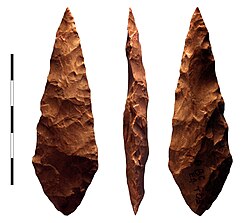
The Blombos Cave sequence is renowned for its collection of Still Bay points. These are bifacially worked stone points—meaning they were flaked on both sides—often described as "laurel leaf" or "willow leaf" shaped due to their elliptic to lanceolate forms and pointed ends.
Excavations have recovered over 500 points or fragments. The primary material used was silcrete (72%), with quartzite (15%) and quartz (13%) also utilized. While quartz and quartzite were locally available, silcrete may have been transported from sources up to 30 km away, such as Riversdale or Albertinia. Because 90% of these points are classified as "production rejects," researchers believe Blombos Cave functioned as a primary workshop for tool manufacture.
Manufacturing Techniques
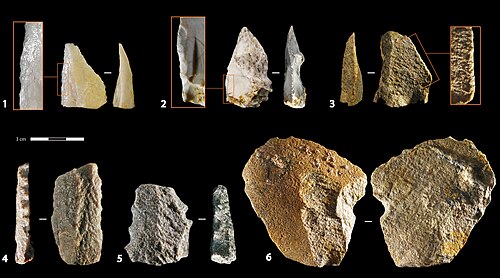
The production of these points followed a rigorous four-phase sequence: initial reduction via hard hammer percussion, followed by soft hammer marginal percussion, and finally, pressure flaking—a technique where a tool is pressed into the stone to remove small, precise flakes. Experimental studies indicate that some silcrete blanks were heat-treated to improve flaking quality.
Function and Symbolism
While these points likely served as knives or spearheads, their aesthetic refinement suggests they may have held symbolic value. They might have acted as markers of identity or been used in social exchange networks to maintain relationships between hunter-gatherer groups.
The Dawn of Abstract Art and Symbolism
Blombos Cave has fundamentally shifted the timeline of human creativity. In 2011, archaeologists identified a rock fragment featuring nine red lines drawn with an ochre crayon, dating to 73,000 years ago. This is recognized as the oldest known abstract drawing by human hands and a prime indicator of modern cognition.
![Claimed "Oldest known drawing by human hands", discovered in Blombos Cave in South Africa. Estimated to be 73,000 years old.[50]](/images/af/37/af370d96a59c0c6735df2b8567d88227583f64b0b188fadb4754b775b0c62c4b.jpg)
Engraved Ochre and Pigments
Ochre, an iron-rich mineral, was central to the lives of the cave's inhabitants. Over 8,000 pieces of ochre-like material have been recovered, many showing signs of intentional processing. Some pieces feature complex cross-hatched and parallel incised lines, representing some of the earliest known conventional design traditions.
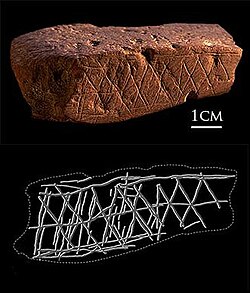
These engravings, along with similar finds at sites like Diepkloof and Wonderwerk Cave, prove that symbolic traditions were common in southern Africa between 70,000 and 100,000 years ago. While ochre was likely used for paint (body or cave art), it may have also served functional purposes, such as a skin protectant, medicine, or hide preservative.
The Ochre Processing Workshop
A 100,000-year-old workshop was discovered containing two toolkits. These included grindstones, hammer-stones, and two abalone shells (Haliotis midae) used to store a liquefied pigment mixture. The preservation of these toolkits was ensured when dune sand encapsulated them shortly after the workshop was abandoned.
Personal Ornamentation and Bone Tools
The discovery of more than 70 Nassarius kraussianus marine shell beads provides evidence of early self-awareness and social convention. These shells were carefully selected for size and color, pierced through the aperture using bone tools, and strung on cord or sinew.
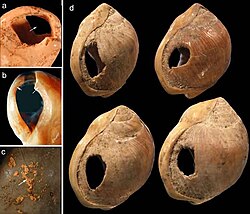
Wear patterns on the beads suggest they were worn as personal ornaments. The variation in bead design over time suggests evolving social conventions. Such behavior implies the existence of syntactical language to communicate the symbolic meaning of these ornaments across generations.
Bone Tool Technology
Though rarer than stone tools, bone awls and polished points have been recovered. Awls were likely used to pierce leather or shells. Some bone points were carefully polished, a process that may have been intended to increase their aesthetic "added value" for social exchange. One bone fragment also features eight parallel engraved lines, mirroring the geometric designs found on the ochre.
Human Presence and Subsistence Strategies
While no complete skeletons have been found, seven recovered teeth show crown diameters consistent with anatomically modern humans. This aligns with findings from the nearby Klasies River Caves.
The inhabitants of Blombos Cave employed a highly diverse diet, blending terrestrial hunting with coastal foraging. Their subsistence included:
- Large Game: Eland and other mammals.
- Small Game: Tortoises, hyraxes, and dune mole rats.
- Marine Life: Seals, dolphins, and whales (likely scavenged), as well as various fish species.
- Shellfish: Giant periwinkles, limpets, and brown mussels.
The presence of a wide variety of fish species suggests the use of advanced methods such as baited hooks, tidal traps, or spearing, contradicting earlier theories that Middle Stone Age humans could not efficiently exploit coastal resources.
| Category | Key Artifacts | Estimated Age/Phase | Significance |
|---|---|---|---|
| Lithics | Still Bay Points | Middle Stone Age | Early pressure flaking; workshop activity |
| Art | Ochre drawings & engravings | 73,000 - 100,000 years | Earliest known abstract representations |
| Ornaments | Nassarius shell beads | Still Bay (M1/M2) | Early social identity and self-awareness |
| Tools | Polished bone points & awls | Still Bay units | Advanced organic material processing |
Frequently Asked Questions
What makes the Blombos Cave drawings so important?
They are considered the oldest known abstract drawings created by humans, dating back 73,000 years. This provides critical evidence that modern cognitive abilities, such as symbolic thought and creativity, developed much earlier than previously thought.
What are Still Bay points?
Still Bay points are bifacially worked stone tools, often leaf-shaped, that characterize the Still Bay techno-complex. They are significant for showing early evidence of pressure flaking and potential symbolic use as identity markers.
How do the shell beads prove early human cognition?
The selection, drilling, and wearing of beads suggest self-recognition and the use of symbols to communicate social status or identity. This process likely required a complex language to transmit the meaning of these ornaments within a group.
Did the people of Blombos Cave only eat seafood?
No, they had a broad subsistence strategy. While they heavily exploited shellfish and fish, they also hunted large mammals like eland and trapped smaller animals like tortoises and hyraxes.
Was ochre used only for art?
While the engraved pieces suggest symbolic use, ochre may have also had functional applications, including use as a medicine, a preservative for hides, or protection against insects and the sun.