
Carlos Romero Barceló: A Legacy of Puerto Rican Politics and Statehood
Carlos Romero Barceló stands as one of the most influential and polarizing figures in the modern political history of Puerto Rico. A lifelong and ardent advocate for statehood—the proposal for Puerto Rico to become a full state of the United States—his career spanned several decades and multiple levels of government, from the mayoralty of the capital city to the halls of the U.S. Congress.
His political journey began with a commitment to the pro-statehood movement. In 1965, he joined "Ciudadanos pro Estado 51" (Citizens for the 51st State) and later became a founder of "Estadistas Unidos," a group established by Luis Ferré. These efforts culminated in 1967 when he became a founding member of the New Progressive Party (PNP), the primary political vehicle for statehood advocates on the island.
The Mayoralty of San Juan
In 1968, Romero Barceló made history by becoming the first popularly elected Mayor of San Juan. Previously, mayors were appointed by the San Juan City Council; his victory marked a shift toward direct democratic election by the electorate. During his tenure, he focused heavily on urban modernization.
One of his most significant achievements was integrating San Juan into U.S. President Lyndon Johnson's Model Cities Program. This initiative transformed "El Fanguito," a slum area, into a modern district featuring the San Juan Natatorium, the Puerto Rico Coliseum, and various residential condominium projects. He also oversaw the construction of the Roberto Clemente Coliseum and established the Colegio Universitario de San Juan, the first municipal educational institution in Puerto Rico.
His leadership extended beyond the island; in 1973, he became the first Hispanic vice-president of the National League of Cities, later serving as the organization's president in 1974.
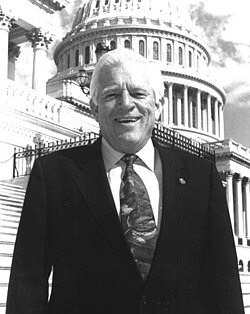
Tenure as Governor of Puerto Rico
Romero Barceló transitioned to the governorship in 1976 after defeating incumbent Rafael Hernández Colón. His administration focused on economic resolutions and the expansion of the tourism industry. However, his economic record was mixed; unemployment saw only a slight decrease, falling from 19.0% in 1975 to 17% by 1979, while government services faced deterioration.
The 1980 Election and Economic Crisis
The 1980 gubernatorial election was one of the closest in the island's history, decided by a narrow margin of 3,037 votes. The result was so contested that the Supreme Court of Puerto Rico had to intervene regarding the validity of certain ballots. A critical factor in his victory was the contribution of the Puerto Rico Statehood Students Association, led by Luis Fortuño, which generated over 1,500 crucial absentee ballots.
Despite winning the governorship, the PNP lost control of the legislature, and party-affiliated mayors won only 28 of the 78 municipalities. His second term was marred by a severe recession from 1980 to 1983, during which unemployment spiked to 25%—the highest level since the Great Depression.
The Cerro Maravilla Incident
Romero Barceló's legacy is inextricably linked to the Cerro Maravilla Incident of 1978. In this event, two pro-independence activists were lured to a mountainous area and killed by rogue members of the Puerto Rican Police. The governor's public description of the officers involved as "heroes" severely damaged his public image. Subsequent investigations by the FBI, the U.S. Justice Department, and the Puerto Rico Justice Department led to the 1984 conviction of 10 police officers for crimes including perjury and obstruction of justice, with some convicted of second-degree murder.
In 1984, he was defeated in his bid for a third term by Rafael Hernández Colón. His reaction to the loss became a piece of political folklore; when asked by reporter Rafael Bracero about his defeat, he famously replied, "¿Derrota, qué Derrota?" (Defeat, what defeat?), arguing that it was merely an "electoral loss."
Later Political Career and Federal Representation
After a brief stint in the Senate of Puerto Rico (1986–1988) and a return to private law practice, Romero Barceló entered the federal arena. In 1992, he was elected as the Resident Commissioner of Puerto Rico, a non-voting member of the U.S. House of Representatives who serves as the island's primary representative in Washington, D.C.
During his tenure in the 103rd through 106th Congresses, he focused on three primary goals: campaigning for statehood, proposing the derogation of the 936 tax code, and endorsing the Young Project, which sought a referendum to resolve the island's political status. He served until 2000, when he was defeated by Aníbal Acevedo Vilá.
The Shadow Senator Role
In 2017, Governor Ricardo Rosselló appointed Romero Barceló as Puerto Rico's first Shadow Senator under the Tennessee Plan. This position, established by Act No. 30, does not allow for official participation in Senate proceedings but provides a platform to advocate for the territory's interests and statehood within the U.S. Senate.
Key Facts
- First Popularly Elected Mayor: He was the first Mayor of San Juan elected directly by the people rather than the City Council.
- Economic Volatility: His governorship saw unemployment peak at 25% during the 1980–1983 recession.
- Cerro Maravilla: His administration was heavily criticized for its handling of the 1978 police killings of pro-independence activists.
- Federal Service: Served as Resident Commissioner in the U.S. Congress from 1993 to 2001.
- Shadow Senator: Appointed in 2017 as the first advocate for Puerto Rico under the Tennessee Plan.
| Role | Period/Year | Key Focus/Outcome |
|---|---|---|
| Mayor of San Juan | 1968–1976 | Urban modernization and Model Cities Program |
| Governor of Puerto Rico | 1977–1985 | Tourism focus; Cerro Maravilla controversy |
| Senator of Puerto Rico | 1986–1988 | Filled a party vacancy |
| Resident Commissioner | 1993–2001 | Statehood advocacy and tax code reform |
| Shadow U.S. Senator | 2017–Present | Advocacy under the Tennessee Plan |
Frequently Asked Questions
What was the significance of Romero Barceló's election as Mayor of San Juan?
He was the first mayor of the capital city to be elected directly by the voters, breaking the tradition of mayors being selected by the San Juan City Council.
What was the "Cerro Maravilla Incident"?
It was a 1978 event where two pro-independence activists were killed by rogue police officers. The incident became a major scandal due to the government's initial handling and Romero Barceló's defense of the officers.
What is a "Shadow Senator" in the context of Puerto Rico?
A Shadow Senator is a non-official representative appointed under the Tennessee Plan to advocate for the territory's interests and statehood in the U.S. Senate, though they cannot vote or participate in official proceedings.
How did the 1980 gubernatorial election end?
Romero Barceló won a second term by a very narrow margin of 3,037 votes over Rafael Hernández Colón, a result that required Supreme Court intervention to resolve ballot disputes.
What was the "Young Project"?
The Young Project was a proposal endorsed by Romero Barceló during his time as Resident Commissioner that sought to hold a referendum to determine the final political status of Puerto Rico.