
Chandelier History: From Ancient Roman Lamps to Modern Lighting
The chandelier has evolved from a basic necessity for illumination into a global symbol of luxury and artistic expression. While we often associate them with glittering crystals and grand ballrooms, the journey of the chandelier spans millennia, reflecting changes in technology, materials, and social status.
Precursors to the Modern Chandelier
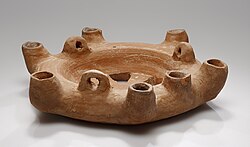
Hanging lighting objects have existed since ancient times. During the Roman period, circular ceramic lamps with multiple wicks or candles were common. The Romans used terms such as lychnuchus or lychnus to describe a variety of lighting fixtures, including candlesticks and chandeliers. By the 4th century, more specific terms like coronae, phari, and pharicanthari emerged, often appearing as prestigious gifts from popes.
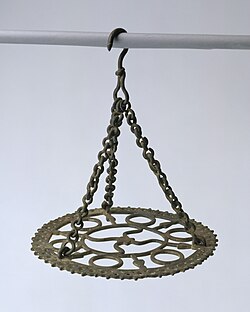
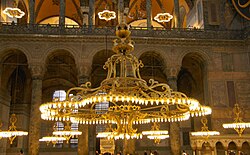
In early religious architecture, these fixtures reached massive proportions. Paul the Silentiary described huge hanging silver discs in the Hagia Sophia in 563, which held fire-wrought glass to illuminate the church. Other notable early examples include a chandelier presented by Pope Adrian I to St. Peter's Basilica in the 8th century, capable of holding 1,370 candles, and the phari mentioned by the Venerable Bede in English churches, which often consisted of large bronze hoops hung over a cross.
The Rise of Early Chandeliers
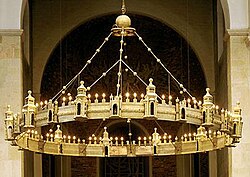
During the medieval period, the corona (crown of light) became a staple in European religious buildings. These were circular, crown-shaped devices made of iron. By the 11th and 12th centuries, larger Romanesque and Gothic wheel chandeliers appeared in Germany, France, and the Netherlands. Notable surviving examples include the Azelin and Hezilo chandeliers in Hildesheim Cathedral and the Barbarossa Chandelier in Aachen Cathedral.
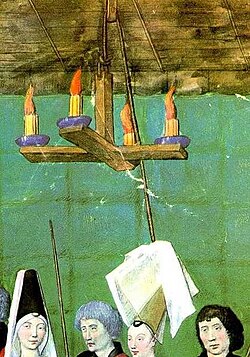
These early structures utilized prickets (vertical spikes) to hold candles and cups for oil and wicks. While religious fixtures were often iron and decorated with polychrome paint or enamel, domestic lighting for the wealthy was simpler. Early home lighting consisted of wooden candle beams or hanging candlesticks attached to vertical pillars. These wooden designs remained in use through the 15th-century court of Charles VI of France and the 16th-century estate of Henry VIII.
Materials and Status Symbols
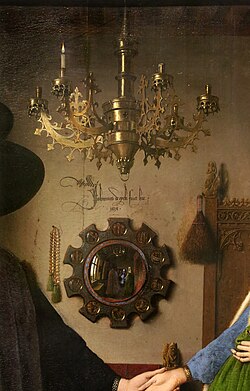
As the late Gothic period progressed, chandeliers became more complex, featuring radiating branches and tiers adorned with statuettes. Because of their high cost, they became symbols of luxury for the nobility and clergy. Materials varied widely: Germany produced lusterweibchen (chandeliers made of deer antlers and sculpted wood), while the king of Mutapa used ivory. Other common materials included gesso, bronze, lead, and eventually porcelain in the 18th century.
The Era of Brass and Metalwork
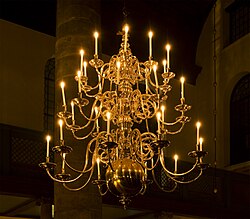
Brass became a preferred material because it mimicked the appearance of gold while being more affordable and easier to manipulate. Since the medieval period, brass-type alloys—particularly dinanderie from Dinant, Belgium—were widely used. By the 15th century, candle nozzles replaced prickets as production techniques allowed for candles of uniform size.
The Evolution of Glass and Crystal
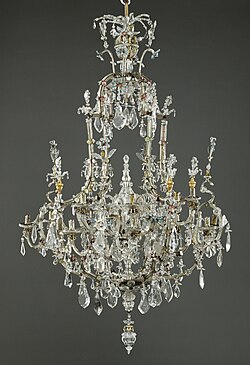
The transition to crystal began in the late 16th century in Milan, where expensive rock crystals (quartz) were cut into pendants and drops. In 17th-century France, these evolved into chandeliers de crystal, reflecting the Baroque and later Rococo styles. The most opulent examples were created for Louis XIV at the Palace of Versailles.
By the late 17th century, cut glass began replacing rock crystal. A pivotal development occurred around 1675 when George Ravenscroft developed lead glass. Unlike soda glass, lead glass was clearer, more resonant when struck, and softer, allowing it to be faceted without shattering. This material is the only glass traditionally described as true "crystal."
Regional Styles: Bohemia and Murano
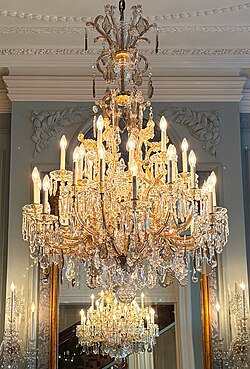
Bohemia (modern-day Czech Republic) became famous for potash glass, which offered a clear, colorless appearance. The Maria-Theresa style, named after the Empress of Austria, is a hallmark of Bohemian design, featuring curved flat metal arms and glass rosettes without a central baluster.
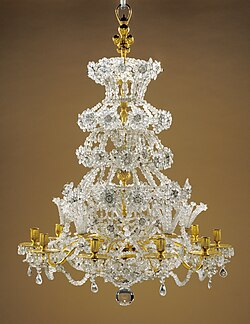
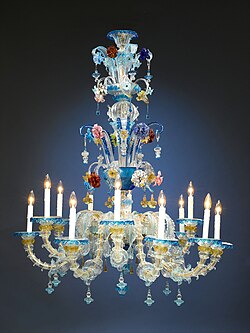
In Venice, the ciocca (bouquet of flowers) style of Murano glass emerged. These chandeliers featured blown glass decorations of fruits, leaves, and polychrome flowers. Murano designs have remained remarkably consistent, with modern versions often mirroring those from the 18th century.
Industrialization and the 19th Century
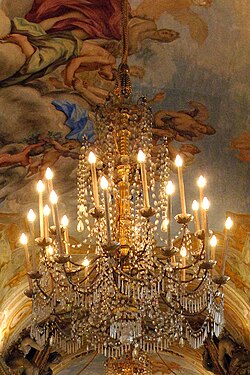
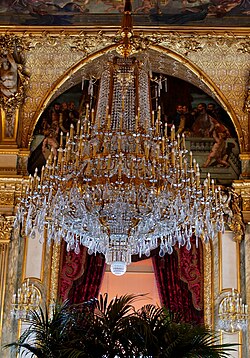
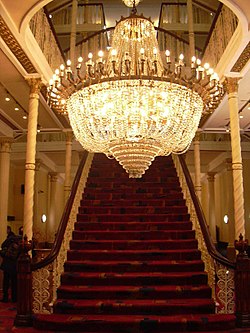
The 19th century saw a peak in chandelier production due to the Industrial Revolution. France became a leader in high-quality glass, with Baccarat starting production in 1824. In England, firms like F. & C. Osler exported massive fixtures to India. One of the largest English-made chandeliers, weighing 4.5 tons with 750 lamps, resides in the Dolmabahçe Palace in Istanbul.
Economic factors also influenced design. The Glass Excise Act of 1811 in England led makers to reuse broken glass cut into icicles to avoid taxes, resulting in the "tent" or "canopy" style of the Regency era. In France, similar designs were known as Empire style, while the simpler Neoclassical look was called Directoire style.
From Gasoliers to Electricity
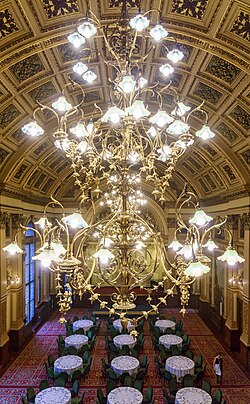
Lighting technology shifted from candles to colza oil, kerosene, and eventually gas. Gasoliers (a portmanteau of gas and chandelier) featured hollow arms to transport gas to burners. While bright, gas light was often considered harsh, leading to the addition of shades to soften the glare. By the early 20th century, electric light bulbs replaced gas.
![Chandeliers in the Banqueting Room of Royal Pavilion were lit by oil and gas[67]](/images/d7/99/d799d8bcd2ce4760aaa838abb1a68fec2a016ede4a759f12ef8f80eaf28dfd7d.jpg)
Modern Chandeliers
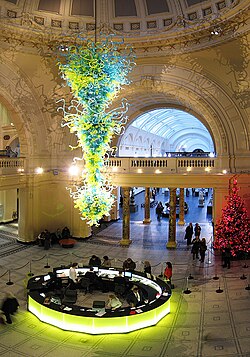
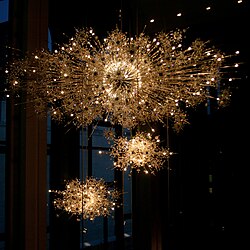
The 20th century saw a decline in traditional chandeliers as Art Nouveau, Art Deco, and Modernism favored different aesthetics. However, a revival occurred toward the end of the century, with artists like Dale Chihuly treating chandeliers as decorative focal points rather than mere light sources.
Modern fixtures utilize a range of technologies, from incandescent and halogen to LED lamps. Many antique pieces have been retrofitted with electricity, using imitation candles and dimmable bulbs to mimic the soft glow of original candlelight.
Key Facts
- First True Chandeliers: Large Romanesque wheel chandeliers from the 11th and 12th centuries in Germany, France, and the Netherlands.
- Lead Glass: Developed by George Ravenscroft c. 1675, enabling the creation of clear, faceted "crystal" glass.
- Maria-Theresa Style: A famous Bohemian design characterized by curved metal arms and glass rosettes.
- Gasoliers: 19th-century fixtures designed specifically for gas lighting with hollow arms.
- World Record: The chandelier in Dolmabahçe Palace weighs 4.5 tons and holds 750 lamps.
| Period | Primary Materials | Lighting Source |
|---|---|---|
| Ancient Roman | Ceramic, Bronze | Oil, Candles |
| Medieval | Iron, Wood, Brass | Oil, Candles |
| 17th-18th Century | Rock Crystal, Lead Glass, Brass | Candles |
| 19th Century | Cut Glass, Metal | Gas, Kerosene, Oil |
| 20th Century-Present | Various (Glass, Metal, Acrylic) | Electricity (LED, Incandescent) |
Frequently Asked Questions
What is the difference between rock crystal and glass chandeliers?
Rock crystal chandeliers are made from naturally occurring quartz, which is highly reflective and expensive. Glass chandeliers use man-made glass; while early versions were soda glass, the development of lead glass in the 17th century allowed for a clearer, more resonant material that closely resembles rock crystal.
What is a gasolier?
A gasolier is a 19th-century branched ceiling fixture designed for gas lighting. The term is a blend of "gas" and "chandelier." Unlike candle chandeliers, gasoliers have hollow arms to carry gas to the burners.
What defines the Maria-Theresa style?
The Maria-Theresa style is a Bohemian design that lacks a central baluster. It is distinguished by curved, flat metal arms positioned between sections of molded glass joined by glass rosettes.
Why did English chandeliers adopt a "tent" or "canopy" design in the 19th century?
This design emerged as a way to avoid the Glass Excise Act of 1811. Makers used broken glass pieces cut into icicles and strung together to create a canopy or waterfall effect, which allowed them to bypass taxes on certain glass products.
What is a Murano ciocca chandelier?
A ciocca, meaning "bouquet of flowers," is an ornate Murano glass chandelier decorated with blown glass flowers, fruits, and leaves. These designs typically leave the center relatively empty, spreading decorations around the outer perimeter of the arms.