
Compressibility Factor: Temperature and Pressure Dependence in Gases
In the study of thermodynamics, the compressibility factor (Z) serves as a critical measure of how much a real gas deviates from ideal gas behavior. While an ideal gas assumes no interactions between molecules, real gases are influenced by intermolecular forces that cause their volume to differ from theoretical predictions. By analyzing the behavior of molecular nitrogen (N2), we can observe how temperature and pressure dictate these deviations.
Key Facts
- Z = 1 indicates ideal gas behavior.
- Z < 1 occurs when attractive intermolecular forces dominate, reducing the gas volume.
- Z > 1 occurs when repulsive intermolecular forces dominate, increasing the gas volume.
- For N2, the normal boiling point is 77.4 K and the critical point is 126.2 K at 34.0 bar.
- The Boyle temperature for N2 is 327 K, where attractive and repulsive effects cancel at low pressure.
The Role of Intermolecular Forces
The deviation of Z from unity is driven by the competition between attractive and repulsive forces. Attractive forces pull molecules together, making the volume smaller than that of an ideal gas (Z < 1). Conversely, repulsive forces push molecules apart, making the volume larger (Z > 1). As temperature increases, the relative influence of attractive forces decreases, while repulsive forces remain largely unaffected.
Using data from the NIST Chemistry WebBook, the behavior of N2 illustrates these principles across various thermal regimes. At low pressures, all gases approach the ideal value of Z = 1, but they diverge as pressure increases.
Temperature Regimes and Gas Behavior
Low Temperature Behavior
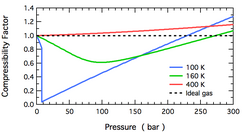
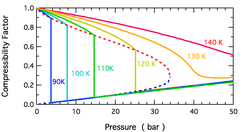
At low temperatures (e.g., 100 K), the compressibility factor exhibits a characteristic check-mark shape. As pressure initially rises, Z decreases because the molecules are brought closer together, enhancing attractive interactions. Eventually, the gas reaches the gas-liquid coexistence curve—the boundary where attractive forces overcome thermal motion, causing the gas to condense into a liquid.
During this phase transition, the system can exist as both gas and liquid, resulting in two possible values for Z: a higher value for the gas phase and a lower value for the liquid phase. Once fully liquefied, the volume becomes resistant to further pressure increases, and Z becomes nearly proportional to pressure.
Intermediate and Critical Temperatures
At intermediate temperatures (e.g., 160 K), the sharp phase transition disappears, replaced by a smooth curve with a broad minimum. This is because the temperature has exceeded the critical point (126.2 K for N2). Above this temperature, there is no distinct phase transition; instead, the gas gradually transforms into a dense, liquid-like state as pressure increases.
High Temperature Behavior
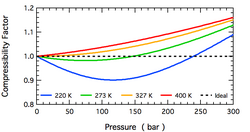
At high temperatures (e.g., 400 K), repulsive interactions dominate at all pressures, keeping Z above unity. As temperature rises, the pressure at which Z reaches its minimum decreases, and the point where repulsive forces begin to dominate (where Z crosses from below 1 to above 1) also shifts to lower pressures.
The Boyle Temperature
A unique state occurs at the Boyle temperature, which is 327 K for molecular nitrogen. At this specific temperature, the attractive and repulsive forces effectively cancel each other out at low pressures. Consequently, Z remains at the ideal value of unity across a range of several tens of bar. Above the Boyle temperature, Z is always greater than unity and increases steadily with pressure.
Summary of N2 Compressibility Characteristics
| Parameter/Condition | Value/Behavior | Dominant Force |
|---|---|---|
| Normal Boiling Point | 77.4 K | Attractive |
| Critical Point | 126.2 K / 34.0 bar | Transition |
| Boyle Temperature | 327 K | Balanced (at low P) |
| T < Critical Point | Phase transition to liquid | Attractive $\rightarrow$ Repulsive |
| T > Boyle Temp | Z always > 1 | Repulsive |
Frequently Asked Questions
What does it mean when the compressibility factor Z is less than 1?
When Z is less than 1, it indicates that attractive intermolecular forces are dominating, pulling the molecules closer together and resulting in a smaller volume than predicted by the ideal gas law.
What happens to a gas at the critical point?
At the critical point, the distinction between the gas and liquid phases disappears. For temperatures above the critical point, a gas cannot be liquefied by pressure alone and instead transforms gradually into a dense fluid.
How does temperature affect the attractive forces between molecules?
Increasing the temperature increases the thermal motion of the molecules, which reduces the relative impact of attractive intermolecular forces, making the gas behave more like an ideal gas at low to moderate pressures.
What is the significance of the Boyle temperature?
The Boyle temperature is the specific temperature at which the attractive and repulsive forces cancel each other out at low pressures, causing the real gas to behave ideally (Z = 1) over a wider range of pressures.
Why does Z increase at very high pressures regardless of temperature?
At very high pressures, molecules are forced so close together that their electron clouds overlap, making repulsive forces the dominant interaction. This increases the volume relative to an ideal gas, pushing Z above unity.