
Redlich-Kwong Equation of State: Principles and Applications
In the study of thermodynamics, predicting how gases behave under varying pressures and temperatures is essential for chemical engineering and physics. While the ideal gas law provides a basic framework, real gases often deviate from this behavior due to molecular interactions. The Redlich-Kwong equation is a sophisticated equation of state designed to provide a more accurate description of real gas behavior by accounting for molecular attraction and the physical volume occupied by molecules.
The Fundamental Equation
The Redlich-Kwong equation modifies the basic gas laws to better reflect reality. It is formulated as:
p = R T / (Vm - b) - a / (√T Vm (Vm + b))
In this expression, p represents the gas pressure, R is the gas constant, T is the temperature, and Vm is the molar volume (defined as total volume V divided by the number of moles n). To correct for the non-ideal nature of gases, two specific constants are used:
- a: A constant that corrects for the attractive potential between molecules.
- b: A constant that corrects for the volume occupied by the molecules themselves (covolume).
These constants vary depending on the specific gas being analyzed and are derived from the gas's critical point data—the specific temperature (Tc) and pressure (Pc) at which the liquid and gas phases become indistinguishable.
Calculating Constants and Compressibility
The constants a and b can be calculated using the following formulas based on critical data:
- a = 0.42748 R2 Tc2.5 / Pc
- b = 0.08664 R Tc / Pc
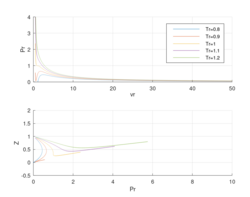
Beyond pressure, the equation is frequently used to determine the compressibility factor (Z), which measures how much a real gas deviates from ideal behavior. Z is defined as Z = pVm / RT. The Redlich-Kwong model expresses Z as a function of temperature and pressure, which can be solved numerically or via cubic functions of the molar volume.
For all gases following the Redlich-Kwong model, the compressibility factor at the critical point (Zc) is always exactly 1/3.
Reduced Form and Fugacity
To generalize the equation across different gases, scientists use reduced variables. These are dimensionless ratios: reduced pressure (pr = p/Pc), reduced volume (Vr = Vm/Vm,c), and reduced temperature (Tr = T/Tc). In this reduced form, the equation becomes:
pr = 3 Tr / (Vr - b') - 1 / (b' √Tr Vr (Vr + b'))
where b' ≈ 0.26. Additionally, the Redlich-Kwong equation allows for the estimation of the fugacity coefficient (ϕ), a critical value used to describe the chemical potential of a real gas in a mixture.
Critical Constants and Molar Volume
The relationship between the constants is reversible. If the values of a and b are known, the critical temperature (Tc) and critical pressure (Pc) can be derived. Once these are established, the critical molar volume (Vm,c) can be found using the relationship Vm,c = Zc R Tc / Pc, which simplifies to Vm,c = b / (∛2 - 1).
| Parameter | Symbol | Physical Meaning | Dependency |
|---|---|---|---|
| Attractive Constant | a | Corrects for molecular attraction | Tc, Pc |
| Volume Constant | b | Corrects for molecular volume | Tc, Pc |
| Compressibility Factor | Z | Deviation from ideal gas law | p, Vm, T |
| Critical Compressibility | Zc | Compressibility at critical point | Constant (1/3) |
Application to Gas Mixtures
The Redlich-Kwong equation is highly versatile and can be applied to mixtures of multiple gases using van der Waals one-fluid mixing and combining rules. In a mixture, the parameters a and b are calculated as weighted averages based on mole fractions (xi).
Handling Volume (b)
The mixture volume parameter b is the sum of the components' b values weighted by their mole fractions. For interactions between different species (i and j), a cross-term bij is used, often adjusted by an empirical interaction parameter (lij) to account for asymmetry.
Handling Attraction (a)
The attractive term a is more complex, as it depends on the square of the mole fractions. The interaction between two different species (aij) is generally assumed to be the geometric average of their individual a terms, further adjusted by an empirical interaction parameter (kij).
Key Facts
- The Redlich-Kwong equation improves upon the ideal gas law by adding constants for molecular attraction (a) and volume (b).
- The compressibility factor at the critical point (Zc) is always 1/3 for this model.
- Constants a and b are derived from the critical temperature (Tc) and critical pressure (Pc) of the gas.
- The equation can be solved as a cubic function of molar volume.
- Mixtures are handled using van der Waals one-fluid mixing rules, incorporating empirical interaction parameters.
Frequently Asked Questions
What is the primary purpose of the Redlich-Kwong equation?
Its primary purpose is to provide a more accurate mathematical description of the behavior of real gases compared to the ideal gas law, specifically by accounting for molecular attraction and the physical space molecules occupy.
How does the Redlich-Kwong equation handle gas mixtures?
It uses mixing rules where the parameters a and b are calculated as weighted averages of the individual components' parameters, often utilizing empirical interaction parameters to account for asymmetries between different molecular species.
What is the significance of the compressibility factor Z in this model?
The compressibility factor Z quantifies the deviation of a real gas from ideal behavior. In the Redlich-Kwong model, Z is implicitly defined as a function of pressure and temperature and is exactly 1/3 at the critical point.
What are the critical constants Tc and Pc?
Tc (critical temperature) and Pc (critical pressure) are the properties of a substance at its critical point, where the distinction between liquid and gas phases disappears. These values are used to calculate the constants a and b.
Can the Redlich-Kwong equation be solved analytically?
Yes, because the equation can be expressed as a cubic function of the molar volume, it can be solved using analytic solutions for cubic functions, though it is now more commonly solved numerically via computer.