
Cuba's Sugar Industry and the Legacy of Valle de los Ingenios
From the earliest days of Spanish settlement, sugar production served as a cornerstone of the Cuban economy. Introduced to the island in 1512, sugar cane flourished thanks to a combination of ideal soil and a favorable climate. This industry brought immense wealth to the town of Trinidad and its surrounding regions, eventually propelling Cuba to become the world's leading sugar producer during the late 18th and 19th centuries.
The efficiency of the industry relied heavily on logistics. To ensure refined sugar reached markets without spoiling, rapid transport was essential. In the late 1880s, a specialized railway line was constructed through the valley, linking the Valle de los Ingenios (Valley of the Sugar Mills) with Trinidad and the coastal port of Casilda, located 6 km (4 mi) from the town. The region's productivity was further supported by a network of rivers, including the Agabama, Rio Caracusey, Rio de Ay, and Rio Tayaba.
Key Facts
- Introduction: Sugar cane was brought to Cuba by the Spanish in 1512.
- Peak Era: Cuba was the world's top sugar producer in the late 18th and 19th centuries.
- Infrastructure: A railway was built in the late 1880s to connect the valley to the port of Casilda.
- Labor History: Following the decline of native populations, enslaved Africans were imported to work the fields and mills.
- Landmark: The Iznaga Tower, built in 1816, was once the tallest structure in Cuba.
The Human Cost of Production
The prosperity of the sugar industry came at a devastating human cost. The native Cuban population was virtually extinguished due to attrition from poor treatment as slaves and the introduction of European diseases. To fill this labor void, Spanish plantation owners imported enslaved Africans to work in the mills and cane fields.
While the Spanish abolished slavery in 1820, making the import of enslaved people more difficult, the system persisted in various forms. The economic dominance of the region finally collapsed during the 19th-century Wars of Independence, which left many sugar mills abandoned or in ruins.
Architectural Remnants of the Colonial Era
Today, while many mills have vanished, several significant structures remain. At Guachinango, the original plantation house is still standing. Another notable site is the Manaca Iznaga plantation, which preserves the owner's house, a prominent tower, and barracones—the original quarters used to house enslaved workers.
While the barracones are currently used as housing and remain in poor condition, the main house has been converted into a restaurant and is well-maintained alongside the famous Iznaga Tower.
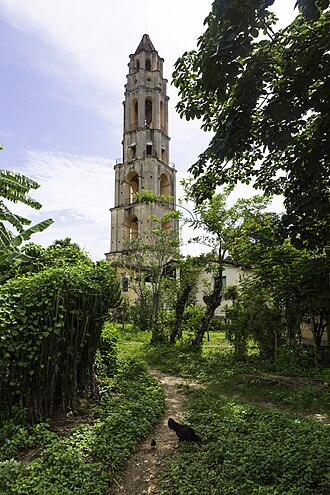
The Iznaga Tower
Constructed in 1816 by Alejo Maria Iznaga y Borrell, the 45-meter (147 ft) tower was a symbol of power and social stature. At the time of its completion, it was the tallest structure in Cuba. The tower served practical and psychological purposes; a bell at the top signaled the start and end of the workday, called for prayers to the Holy Virgin three times a day, and sounded alarms for fires or slave escapes.
The tower remains a recognized landmark, testifying to the material wealth of the Spanish colonial period. The large bell that once governed the rhythm of the plantation now rests at the foot of the tower.
Summary of Regional Geography and Infrastructure
| Feature | Details |
|---|---|
| Key Rivers | Agabama, Rio Caracusey, Rio de Ay, Rio Tayaba |
| Primary Export Port | Casilda (6 km from Trinidad) |
| Transport Innovation | Specialized railway line (late 1880s) |
| Notable Sites | Manaca Iznaga, Guachinango |
Frequently Asked Questions
When was sugar cane introduced to Cuba?
Sugar cane was introduced to the island by the Spanish in 1512.
What was the purpose of the Iznaga Tower?
The tower was used to display the owner's power and status. Practically, its bell signaled work hours, prayer times, and alarms for fires or escapes.
Why was a railway built in the Valle de los Ingenios?
The railway was constructed in the late 1880s to ensure the rapid transport of refined sugar to the port of Casilda to prevent the commodity from spoiling.
What happened to the sugar industry during the 19th century?
The economic dominance of the area ended during the Wars of Independence in the 19th century, leading to the abandonment and decay of many sugar mills.
What are barracones?
Barracones are the original quarters used to house enslaved people on the plantations.