
Farum Line: A History of Copenhagen's S-Train Extension
The Farum Line stands as a unique piece of Copenhagen's transit puzzle. Originally conceived as a private venture to connect the city with the rural outskirts, it has evolved from a leisure route for city dwellers into a vital part of the S-train (S-tog) network—the suburban rail system serving the Copenhagen metropolitan area.
The line first opened in 1906 as part of the private København-Slangerup Jernbane. At its inception, the railway extended beyond Farum to Slangerup, covering a distance that reached approximately two-thirds of the way from Farum to Frederikssund. Its original city terminus was København L, located near the modern-day Nørrebro station. While the station building still exists, it was always intended to be a temporary solution until the city's broader railway routing was finalized.
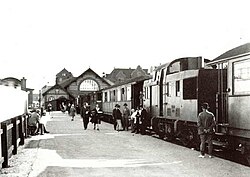
The Early Years and Transition to State Control
In its early decades, the line served a specific social purpose. A significant portion of its traffic consisted of leisure travelers—largely the working-class population of Nørrebro—heading to the Hareskoven forest for recreation.
However, the private company struggled financially over time. By 1929, the majority of private investors sold their shares to the municipalities along the route. Following the devastation of World War II, the infrastructure had deteriorated to the point that the state railways, DSB (Danske Statsbaner), took over operations in 1948. By 1954, the outer section between Farum and Slangerup was abandoned due to lack of profitability.
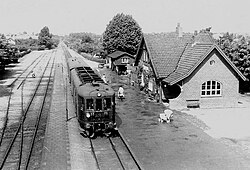
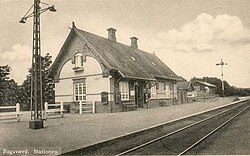
The Path to Electrification
The transition to the modern S-train system was a slow process. Although an act authorizing electrification was passed in 1961, a lack of public funding delayed the project for years. It was not until 1977 that S-trains finally began operating on the line.
The original vision for the line included an underground extension from København L directly into the city center. By the 1960s, however, it became clear that funding for a metro-style construction was unavailable. Consequently, planners abandoned the innermost few kilometers of the original line. They replaced them with a large "S-curve" that connected the line to the existing S-train trunk at Svanemøllen, including a new overpass and interchange with the ring line at Ryparken.
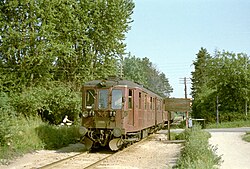
This rerouting meant that diesel trains moved their terminus to Svanemøllen in early 1976, with the full S-train conversion completed a year and a half later. While this was the longest single addition to the S-train network at the time, the indirect route increased travel times to the city center, making the line less competitive than direct bus routes and resulting in lower patronage at several stations.
Technical Oddities and Preserved Routes
The Farum Line retains a rare technical characteristic: the few hundred meters of track between the Farum platforms and the bridge across Fiskebæk valley remain the only piece of single-tracked railway on the entire S-train network.
Beyond the active line, remnants of the original Slangerupbanen (the Slangerup Line) can still be found. Approximately 2.5 km of the 13.7 km disused route is preserved and accessible to the public, including sections in Farum Lillevang, Lynge, and Uggeløse Forest.
Key Facts
- Opened: 1906 as the København-Slangerup Jernbane.
- State Takeover: DSB assumed control in 1948.
- S-Train Conversion: Completed in 1977.
- Unique Feature: Contains the only single-track section in the S-train network.
- Original Terminus: København L (Lygten Station).
- Current Connection: Linked to the S-train trunk at Svanemøllen via Ryparken.
Station and Route Overview
The following table outlines the key stations and historical stops along the line's evolution.
| Station Name | Km | S-train Service | Connections |
|---|---|---|---|
| Svanemøllen (Former København L) | 0.0 | B, Bx | Nordbanen & Klampenborgbanen |
| Ryparken (formerly Lyngbyvej) | - | B, Bx | Ringbanen |
| Emdrup | 2.7 | B, Bx | - |
| Dyssegård | 3.7 | B, Bx | - |
| Vangede | 4.9 | B, Bx | - |
| Buddinge | 6.9 | B, Bx | - |
| Bagsværd | 10.4 | B, Bx | - |
| Hareskov | 13.5 | B | - |
| Værløse | 16.7 | B | - |
| Farum | 20.5 | B | - |
Frequently Asked Questions
Why is the travel time to the city center higher on the Farum Line?
Because the original direct route from København L to the city center was abandoned due to funding issues, the line was rerouted via a large S-curve to connect at Svanemøllen, making the journey less direct.
What is unique about the tracks at Farum station?
The section of track between the Farum platforms and the bridge across Fiskebæk valley is the only remaining single-track section in the entire S-train network.
When did the line stop running to Slangerup?
The outer end of the line between Farum and Slangerup was abandoned in 1954 because it was no longer profitable.
Who originally owned the railway?
The line was opened in 1906 as a private venture called the København-Slangerup Jernbane before being sold to municipalities in 1929 and eventually to DSB in 1948.
Can you still visit the old railway route?
Yes, approximately 2.5 km of the disused route is preserved and accessible, including sections in Uggeløse Forest and near Lindholm Station.