
John Wanamaker and the Legacy of the Wanamaker Building
Long before the era of modern shopping malls, John Wanamaker transformed the retail landscape of America. Starting his professional journey at age 19 as the first corresponding secretary for the national YMCA organization, Wanamaker would eventually redefine how consumers shopped and how businesses treated their customers. His vision culminated in the creation of a Philadelphia institution that blended commerce with art and architecture.
The Rise of a Retail Pioneer
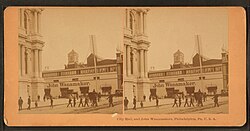
In 1861, Wanamaker entered the retail world by opening "Oak Hall" at 6th and Market Streets in Philadelphia, in partnership with his brother-in-law, Nathan Brown. The store was strategically located adjacent to the site where George Washington once lived and worked during his presidency. Oak Hall achieved rapid growth by implementing a revolutionary business model: "One price and goods returnable."
Following the death of Nathan Brown, Wanamaker expanded his reach, opening a second store at 818 Chestnut Street in 1869 and renaming the company John Wanamaker & Co. By 1875, he converted an abandoned railroad depot into "The Grand Depot," which is recognized as the first department store in Philadelphia.
Innovations in Commerce and Advertising
Wanamaker is credited with several industry standards that are now commonplace. While he did not invent the fixed price system, he created the price tag and popularized it as the standard for retail. He also pioneered the money-back guarantee, ensuring customer trust and satisfaction.
A firm believer in the power of advertising, Wanamaker was the first retailer to place a half-page newspaper ad in 1874 and a full-page ad in 1879. He eventually hired John Emory Powers, the world's first full-time copywriter, under whose tenure company revenues doubled from $4 million to $8 million. Despite his success, Wanamaker famously remarked, "Half the money I spend on advertising is wasted; the trouble is I don't know which half."
The Wanamaker Building
The pinnacle of Wanamaker's architectural ambition was the Wanamaker Building. Completed in 1910 and designed by Chicago architect Daniel H. Burnham, this 12-story granite structure occupies an entire block at 13th and Market Streets, directly across from Philadelphia City Hall. The building was officially dedicated by U.S. President William Howard Taft on December 30, 1911.
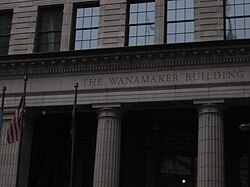
While the building initially served as both a department store and company offices, it has remained a cultural pillar of the city. In 2018, the upper office tower was marketed as the Wanamaker Office Building.
The Grand Court
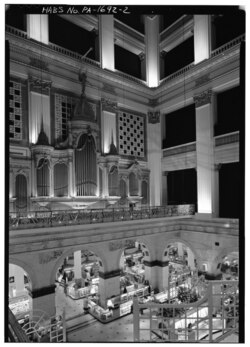
The building's most iconic feature is the Grand Court, a seven-story, marble-clad central atrium. This stunning space has served as a backdrop for several films, including Nasty Habits (1977), Blow Out (1981), Mannequin (1987), and 12 Monkeys (1995).
The Wanamaker Organ
Housed within the Grand Court is the Wanamaker Grand Court Organ, a masterpiece of the American Symphonic school of design. Originally built by the Los Angeles Art Organ Company for the 1904 St. Louis World's Fair, the instrument cost $105,000 (approximately $3,760,000 today). Wanamaker purchased it in 1909, transporting it via 13 freight cars.
The organ's growth was immense: starting with 10,059 pipes, it expanded by 1917 and again by 1930 to reach a total of 28,750 pipes. The instrument is designed to blend traditional organ sounds with the tonal colors of a symphony orchestra. Every June, the city celebrates "Wanamaker Organ Day" with a free festival.
The Wanamaker Eagle
Another focal point of the Grand Court is the Wanamaker Eagle, a 2,500 lb (1,100 kg) bronze sculpture by August Gaul. Purchased after the 1904 Louisiana Purchase Exposition, the sculpture is so heavy it requires a steel beam for support. It became such a famous landmark that "Meet me at the Eagle" became a common Philadelphia catchphrase.
Traditions and Employee Relations
The store is also known for its seasonal magic. In 1955, lighting designer Frederick Yost created the "Holiday Light Show" in the Grand Court. This tradition continues today, alongside the "Macy's Dickens Village" on the third floor, which has been a staple since 2006 (continuing a tradition that began at Strawbridge's in 1985).
Wanamaker's approach to employment was complex. He was an early adopter of employee benefits, providing free medical care, education, pensions, and profit-sharing. However, he was a fierce opponent of unionization; in 1887, he fired twelve members of the Knights of Labor after they were discovered by his detectives.
Key Facts
- First Department Store: "The Grand Depot" is considered Philadelphia's first department store.
- Retail Innovations: Popularized the price tag and the money-back guarantee.
- Architectural Scale: The Wanamaker Building is a 12-story granite structure designed by Daniel H. Burnham.
- Musical Marvel: The Grand Court Organ contains 28,750 pipes.
- Iconic Landmark: The Wanamaker Eagle weighs 2,500 lbs.
- Advertising Pioneer: First retailer to use half-page (1874) and full-page (1879) newspaper ads.
| Category | Detail |
|---|---|
| First Store | Oak Hall (1861) |
| Key Innovations | Price tags, Money-back guarantees, Fixed pricing |
| Major Building | Wanamaker Building (Completed 1910) |
| Notable Features | Grand Court, Wanamaker Organ, Wanamaker Eagle |
| Global Reach | Expansion to New York, London, and Paris |
Frequently Asked Questions
What retail practices did John Wanamaker popularize?
John Wanamaker is credited with popularizing the price tag as an industry standard and introducing the money-back guarantee to ensure customer satisfaction.
How many pipes are in the Wanamaker Grand Court Organ?
The organ currently has a total of 28,750 pipes, having grown from its original 10,059 pipes through expansions in 1917 and 1930.
What is the significance of the Wanamaker Eagle?
The Wanamaker Eagle is a 2,500 lb bronze sculpture that serves as a focal point of the Grand Court and became a famous meeting spot for Philadelphians.
Who designed the Wanamaker Building?
The 12-story granite building was designed by the Chicago architect Daniel H. Burnham and was dedicated by President William Howard Taft in 1911.
How did Wanamaker approach advertising?
Wanamaker was a pioneer in newspaper advertising, being the first to use half-page and full-page ads. He also hired the first full-time copywriter, John Emory Powers, which helped double the company's revenues.