
Wanamaker's: The Legacy of an American Retail Pioneer
Long before the era of global e-commerce and national big-box chains, the American retail landscape was transformed by a visionary named John Wanamaker. By blending European luxury concepts with a commitment to consumer rights and employee welfare, Wanamaker created more than just a store; he established a blueprint for the modern department store experience.
The Birth of the Grand Depot
Born in Philadelphia in 1838, John Wanamaker entered the business world after a persistent cough prevented him from serving in the U.S. Army during the American Civil War. In 1861, he co-founded Oak Hall, a men's clothing store, with his brother-in-law Nathan Brown. Following Brown's death in 1868, Wanamaker took sole control of the business.
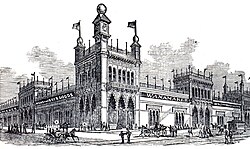
Wanamaker's true ambition materialized in 1876 when he purchased an abandoned Pennsylvania Railroad station. Inspired by the great markets of Europe, such as Paris's Les Halles and London's Royal Exchange, he renovated the terminal into the "Grand Depot." The store opened just in time for the American Centennial Exposition of 1876, featuring a striking Moorish Revival façade that mirrored the pavilions of the world's fair.By 1877, the store expanded beyond men's wear to include women's clothing and dry goods. The layout was a marvel of organization: a central circular counter served as the hub for 129 radiating counters of merchandise. This establishment became Philadelphia's first modern department store and one of the earliest of its kind in the United States.
Revolutionizing the Shopping Experience
Wanamaker was driven by a desire to reform retail principles. After a negative personal experience where a merchant refused an exchange, he implemented policies that prioritized the customer. He introduced the price tag, guaranteed merchandise quality in print, and allowed customers to return purchases for cash refunds. He also pioneered the first in-store restaurant.
His commitment to ethics extended to his advertising and personal life. A practicing Christian, Wanamaker refused to advertise on Sundays and allowed evangelist Dwight L. Moody to use his facilities for meetings, providing 300 store employees to serve as ushers. Starting in 1874, he became the first to copyright retail advertisements, ensuring they remained factual and honest.
Employee Welfare and Corporate Culture
Wanamaker believed in treating staff with respect, forbidding management from scolding employees in public. He provided benefits that were decades ahead of their time, including:
- Access to the John Wanamaker Commercial Institute.
- Free medical care and recreational facilities.
- Profit-sharing plans and pensions.
Technological Firsts
The store was a hub of innovation, consistently adopting new technology to improve efficiency and atmosphere. Wanamaker's was the first department store to implement electrical illumination (1878), install a telephone (1879), and utilize pneumatic tubes (1880) for the rapid transport of cash and documents.
Expansion and the Golden Age
In 1911, the original Grand Depot was replaced by a massive flagship store. The business continued to push boundaries, such as operating a wireless station in New York City that transmitted news of the Titanic's sinking to waiting crowds. In 1918, the store began its tradition of public Christmas Caroling in the Grand Court.
The store's reach was global; by 1919, the New York location featured 100 specialized departments, including a dedicated department for Latin-American personal service. Wanamaker's also pioneered the "White sale" in 1878 and "Opportunity Sales" in February to maintain high volume and low prices. To further enhance the luxury experience, buyers traveled to Europe annually for the latest fashions, and the store broadcast organ concerts via its own radio station, WOO, starting in 1922.
The Transition of Ownership
Following John Wanamaker's death in 1922, his son Rodman Wanamaker took the helm, focusing on imported luxuries and transforming the stores into "temples of the beautiful." However, after Rodman's death in 1928, the business was managed by a trust.
As the 20th century progressed, the rise of national chains like Macy's and Bloomingdale's eroded Wanamaker's market share. The Wanamaker Family Trust sold the company to Carter Hawley Hale Stores in 1978 for $60 million. Despite an additional $80 million investment in renovations, the store struggled to regain its former glory.
In 1986, the chain was sold to Woodward & Lothrop for approximately $180 million. Under A. Alfred Taubman, the company was renamed Wanamaker's Inc., but heavy debt and disappointing sales led to a Chapter 11 bankruptcy filing on January 17, 1994.

The End of an Era: From Hecht's to Macy's
The Wanamaker's chain was sold to May Department Stores Company on June 21, 1995. This marked the end of the 133-year-old Wanamaker's brand, as operations were consolidated into the Hecht's division. The transition continued as May acquired Strawbridge & Clothier in 1996, rebranding Philadelphia Hecht's locations as Strawbridge's.
The historic flagship building underwent several more changes: it became a Lord & Taylor branch in 1997 and was finally converted into a Macy's in 2006 after Federated Department Stores acquired May. In New York, the former Wanamaker's space on Broadway was occupied by Kmart by 1996 and later by Wegmans in 2023.
| Year | Innovation / Event | Significance |
|---|---|---|
| 1876 | Opening of Grand Depot | Philadelphia's first modern department store. |
| 1878 | Electrical Illumination | First department store to use electric lights. |
| 1879 | Telephone Installation | First retail store to utilize the telephone. |
| 1880 | Pneumatic Tubes | First use of tubes for cash and document transport. |
| 1911 | Flagship Store Built | Replacement of the original Grand Depot. |
| 1995 | Acquisition by May | Dissolution of the Wanamaker's brand name. |
Key Facts
- Founder: John Wanamaker, who started with a men's clothing store called Oak Hall in 1861.
- Retail Firsts: Invented the price tag, introduced cash refunds, and created the first in-store restaurant.
- Employee Benefits: Offered free medical care, pensions, and profit sharing long before they were industry standards.
- Technological Pioneer: First to use electric lights, telephones, and pneumatic tubes in a retail setting.
- Final Transition: The brand ended in 1995, eventually evolving into Hecht's, Strawbridge's, and finally Macy's.
Frequently Asked Questions
What was the "Grand Depot"?
The Grand Depot was the original Wanamaker's store opened in 1876 in a renovated Pennsylvania Railroad station. It was designed to mimic the great European markets and featured a Moorish Revival façade.
How did John Wanamaker change the way people shopped?
Wanamaker introduced several modern retail standards, including the invention of the price tag, the ability to return items for a cash refund, and the guarantee of merchandise quality in print.
What happened to the Wanamaker's brand name?
After 133 years of operation, the Wanamaker's name was removed in 1995 when the company was sold to May Department Stores and consolidated into the Hecht's division.
Did Wanamaker's offer benefits to its employees?
Yes, John Wanamaker provided his staff with progressive benefits including free medical care, recreational facilities, pensions, and profit-sharing plans, as well as access to a commercial institute.
What is the current status of the flagship building?
The flagship structure in Philadelphia transitioned through several owners and brands, eventually becoming a Macy's in 2006. Part of the upper floors were also converted into commercial office space.