
Kellingley Colliery: Engineering and Operational History
The development of Kellingley Colliery stands as a testament to mid-century industrial engineering. Following exploratory boreholes in the 1950s, which revealed up to seven workable seams of coal, the site was selected for a major mining operation. The process of bringing the mine into production required overcoming significant geological challenges, particularly regarding water management and structural stability.
The Challenge of Shaft Sinking
Construction began in 1960 with the sinking of two primary shafts. The project faced an immediate obstacle: the geology down to approximately 600 feet (180 m) was sandy, porous, and heavily waterlogged. To prevent the shafts from flooding during excavation, engineers employed a technique known as ground freezing.
Sub-zero-temperature brine was pumped through boreholes drilled around each shaft position, freezing the ground to a depth of about 640 feet (200 m). This created a frozen wall that held back the water, though it required personnel to work in extreme sub-zero temperatures until the shafts penetrated below the frozen layer. Eventually, the shafts reached a total depth of approximately 870 yards (800 m).
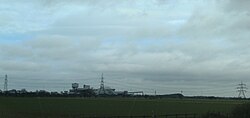
Stabilization and Structural Alignment
Once the shafts were sealed with a concrete lining, the brine cooling was stopped, allowing the ground to thaw. To ensure long-term stability and prevent leaks, engineers used grout—a thin cement mixture—which was pumped at high pressure through the concrete lining into the water-bearing strata. This process stabilized the upper ground and sealed off the remaining water ingress.
The high pressure required for grouting caused the ground above to heave, which slightly tilted the winding engine towers. Because this was anticipated, the towers were designed with four legs that could be jacked up. This adjustment process was performed regularly during the pumping phase to maintain alignment. To ensure the shafts themselves remained perfectly vertical, four evenly spaced steel plumb lines were suspended from the top to the bottom of each shaft.
Production and Workforce Evolution
Kellingley Colliery officially began production in April 1965. While initial planning for the surface infrastructure anticipated a workforce of 3,000 mineworkers, the adoption of updated machinery and more efficient methods reduced the actual requirement to approximately 2,000 employees at any one time.
The colliery became a vital source of employment for the region and beyond. Many miners relocated from Scotland to Kellingley after the closure of Scottish pits during the 1960s. Later in its operational life, the pit received £7.2 million in March 2004 through the Coal Investment Aid Scheme.
Key Facts
- Workable Coal: Up to seven seams identified.
- Shaft Depth: Approximately 870 yards (800 m).
- Ground Freezing: Used to stabilize waterlogged ground down to 640 feet (200 m).
- Production Start: April 1965.
- Workforce: Approximately 2,000 employees (down from an estimated 3,000).
- Financial Aid: £7.2 million received via the Coal Investment Aid Scheme in 2004.
| Feature | Detail |
|---|---|
| Exploration Period | 1950s |
| Shaft Sinking Start | 1960 |
| Frozen Ground Depth | ~640 feet (200 m) |
| Total Shaft Depth | ~870 yards (800 m) |
| Production Date | April 1965 |
Frequently Asked Questions
How did engineers deal with the waterlogged ground during construction?
Engineers used sub-zero-temperature brine pumped through boreholes to freeze the ground down to 640 feet (200 m), creating a stable, frozen barrier that allowed shaft sinking to proceed.
What is grout and why was it used at Kellingley?
Grout is a thin cement mixture. It was pumped at high pressure into water-bearing strata through the shaft's concrete lining to stop water leaks and stabilize the ground around the upper shafts.
Why did the winding engine towers tilt?
The towers tilted because the high pressure used during the grouting process caused the ground above the shafts to heave.
How was the alignment of the shafts maintained?
Alignment was monitored and maintained using four steel plumb lines suspended evenly around the inside of each shaft from the top to the bottom.
How did the actual workforce differ from the original projections?
While 3,000 workers were originally expected, updated machinery and methods meant that only about 2,000 men were employed at any one time.