
Kermadec Plate: Tectonic Dynamics of the South Pacific
Deep within the South Pacific Ocean lies the Kermadec plate, a long and narrow tectonic plate that plays a critical role in the geological shaping of the region. Positioned west of the Kermadec Trench, this plate encompasses not only vast stretches of the ocean floor but also the Kermadec Islands and a small portion of New Zealand's North Island.
The interaction between the Kermadec plate and its neighbors creates a volatile environment characterized by intense geological activity. Because it is situated at the intersection of several massive crustal segments, the region is highly prone to earthquakes and tsunamis.
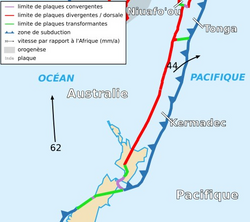
Tectonic Boundaries and Structure
The Kermadec plate is defined by its unique boundaries. To its east lies the Kermadec Trench, while to its west, it is separated from the Australian plate. This separation occurs along a long divergent boundary—a zone where two tectonic plates move away from each other.
This divergence has resulted in the formation of a back-arc basin, a geologic depression that forms behind a volcanic arc. The constant shifting and pulling of the crust in this area contribute to the region's inherent instability.
Convergence Rates and Movement
One of the most striking features of the Kermadec plate is the speed at which it interacts with the Pacific plate. The convergence—the process where two plates move toward each other—occurs at some of the fastest rates recorded on Earth.
The speed of this movement varies by latitude:
- Northern Region: Convergence occurs at a rate of 8 cm (3.1 in) per year.
- Southern Region: Convergence occurs at a rate of 4.5 cm (1.8 in) per year.
Key Facts
- Location: West of the Kermadec Trench in the South Pacific Ocean.
- Landmasses: Includes the Kermadec Islands and part of New Zealand's North Island.
- Boundary Type: Separated from the Australian plate by a divergent boundary.
- Geological Feature: Contains a back-arc basin.
- Maximum Speed: Convergence rates reach up to 8 cm per year in the north.
- Risk Factors: High susceptibility to tsunamis and earthquakes.
| Region | Convergence Rate (cm/year) | Convergence Rate (in/year) |
|---|---|---|
| North | 8 | 3.1 |
| South | 4.5 | 1.8 |
Frequently Asked Questions
Where is the Kermadec plate located?
The Kermadec plate is located in the South Pacific Ocean, situated to the west of the Kermadec Trench.
What landmasses are part of the Kermadec plate?
The plate includes the Kermadec Islands and a small portion of the North Island of New Zealand.
Why is this region prone to earthquakes and tsunamis?
The area is highly active due to the divergent boundary separating it from the Australian plate and the rapid convergence with the Pacific plate.
What is a back-arc basin?
A back-arc basin is a geologic depression formed by a divergent boundary behind a volcanic arc, which in this case separates the Kermadec and Australian plates.
How fast is the Pacific plate moving toward the Kermadec plate?
The convergence rates are among the fastest on Earth, moving at 8 cm per year in the north and 4.5 cm per year in the south.