
McCormick Reaper and the Evolution of International Harvester
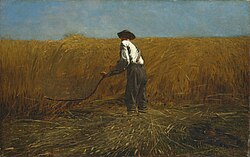
Before the dawn of industrialization, harvesting small grains like wheat was a grueling, manual process. Farmers relied on the scythe—a long-handled curved blade—to cut stalks, which were then tied by hand into bundles to dry. This method was incredibly labor-intensive; a team of six people could typically harvest only about two acres of wheat in a single day. As the Industrial Revolution took hold, inventors began seeking mechanical solutions to accelerate this vital agricultural process.
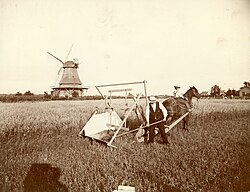
One such innovator was Robert McCormick, a prosperous farmer from Virginia. In the early 1800s, Robert developed a horse-drawn machine designed for reaping (cutting) grain. While Robert possessed the inventive spirit, he lacked the business acumen to scale his creation, and his early patents remained largely confined to his own farm.
The Rise of Cyrus McCormick
The transition from a farm invention to a global industry was driven by Robert's son, Cyrus. A skilled promoter and businessman, Cyrus began staging public demonstrations of the family reaper near his home in 1831 and 1832. Although the machine performed exceptionally well on flat terrain, it struggled on hilly landscapes.
Competition intensified in 1833 when Obed Hussey of Ohio patented his own reaper. This likely prompted Cyrus to secure his own patent in 1834. Rather than rushing to market, the McCormicks spent the remainder of the 1830s refining their design. By 1839, Cyrus resumed demonstrations, selling two homemade reapers in 1840 for $110 each, followed by seven more in 1841.
The superiority of the McCormick design was highlighted in an 1843 competition: while Hussey's reaper managed to cut two acres, McCormick's larger machine successfully harvested seven.
Industrial Expansion and the Chicago Factory
Initially, reapers were built in the McCormick farm shop. In 1844, Cyrus attempted to scale production by licensing the design to other manufacturers, including a firm in upstate New York. However, this led to significant quality control issues. To ensure consistency, Cyrus consolidated all production in 1847 at a new factory in Chicago. This location was strategic, placing the company closer to the grain-growing prairies and vital water transportation routes.
The growth was explosive. By 1849, the Chicago plant was producing 1,500 reapers annually. Even after the Great Chicago Fire of 1871 destroyed the facility, McCormick rebuilt and expanded the product line by acquiring patents from other inventors. A notable acquisition was the "harvester" attachment from the Marsh Brothers, which allowed the machine to bundle grain as it reaped.
By 1884, the single Chicago factory was producing 55,000 machines. By 1902, the company controlled 35% of the entire United States farm machinery market.
The Branch House System and Madison
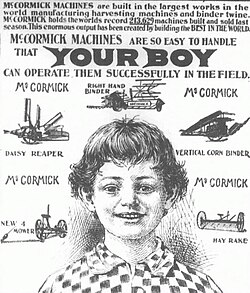
In the 1880s, McCormick revolutionized its distribution by moving from a jobber system to a branch house system. Instead of relying solely on third parties, the company established its own regional outlets. These branch houses served as agents that sold full product lines to independent retailers, who then sold to the farmers.
The branch house operation was highly organized, employing three specific roles:
- Blockmen: Salesmen who managed specific territories.
- Canvassers: Personnel who generated interest among farmers to support blockmen and dealers.
- Machinery Experts: Specialists who handled installation, adjustment, and repairs.
These regional hubs also provided essential financial services, including credit for dealer inventories and collection services.
In 1895, McCormick opened its first branch house in Madison, Wisconsin, leveraging the city's nine radiating rail lines to reach southern Wisconsin and Illinois. In 1897, the company invested $4,500 to build a permanent three-story cream brick building on S. Blount Street. Known as the "King of Implement Row," the building featured a Greek key design and a flat roof.
The Formation of International Harvester
In 1902, a massive merger occurred. McCormick joined forces with the Deering Harvester Company, Plano Harvester Company, Milwaukee Harvester Company, and Warder, Bushnell & Glessner Company to form the International Harvester Company (IH), with Cyrus McCormick Jr. serving as President.
The Madison Branch House was doubled in size in 1909 to accommodate the growing company, with the second floor housing offices and a showroom, and the third floor serving as a parts warehouse. IH utilized the building until 1953, when improved shipping logistics made regional branch houses less necessary.
Key Facts
- Pre-industrial efficiency: Six people could harvest roughly two acres of wheat per day manually.
- Competitive edge: In an 1843 trial, McCormick's reaper cut seven acres compared to Hussey's two.
- Market dominance: By 1902, McCormick produced 35% of all U.S. farm machinery.
- Industrial scale: Production grew from 1,500 reapers in 1849 to 55,000 machines by 1884.
- Corporate evolution: International Harvester was formed in 1902 through the merger of five major harvester companies.
| Year | Milestone / Production Volume | Key Development |
|---|---|---|
| 1834 | Patent Filed | Cyrus McCormick patents the reaper design. |
| 1847 | Chicago Factory | Production consolidated in Chicago for better logistics. |
| 1849 | 1,500 units | Annual reaper production at the Chicago plant. |
| 1884 | 55,000 units | Annual machine production at the Chicago plant. |
| 1902 | 35% Market Share | Formation of International Harvester Company. |
Frequently Asked Questions
Who invented the McCormick reaper?
The machine was originally constructed by Robert McCormick, a Virginia farmer, but it was his son, Cyrus McCormick, who refined the design, patented it in 1834, and turned it into a commercial success.
What was the "branch house system"?
It was a distribution model where the manufacturer established its own regional outlets to act as agents. These houses sold products to independent retailers and provided specialized support via blockmen, canvassers, and machinery experts.
How did the McCormick reaper compare to its competitors?
In a notable 1843 competition, the McCormick reaper demonstrated significantly higher efficiency, cutting seven acres of grain compared to the two acres cut by Obed Hussey's reaper.
What happened to the McCormick company in 1902?
McCormick merged with four other companies—Deering, Plano, Milwaukee, and Warder, Bushnell & Glessner—to create the International Harvester Company.
Why was the Chicago location chosen for the factory?
Chicago was selected in 1847 because it was a frontier town located closer to the grain-growing prairies and offered superior water transportation for shipping machinery.