
Ministry of General Machine-Building: Driving Soviet Space and Missile Technology
The Ministry of General Machine-Building served as a cornerstone of the Soviet Union's strategic capabilities, overseeing the complex intersection of space exploration and intercontinental ballistic missile (ICBM) development. Operating under the coordination of the Military-Industrial Commission of the Soviet Union, the ministry managed various design bureaus, including the renowned OKB-1, to maintain the USSR's technological edge during the Cold War.
Key Facts
- Primary Scope: Managed space technology and liquid-fueled ICBMs.
- Major Systems: Oversaw the development of the RT-2PM Topol and the combat railway missile complex.
- International Diplomacy: Facilitated the 1975 Apollo–Soyuz mission through negotiations with NASA.
- Commercialization: Established Glavkosmos to sell launch services globally during the perestroika era.
- Notable Projects: Co-managed the Buran reusable spacecraft program and initiated the GLONASS satellite navigation system.
Strategic Missile and Space Development
The ministry's portfolio was vast, though it specifically excluded solid-fueled missiles, which were handled by the Moscow Institute of Thermal Technology under the Ministry of Defense Industry. One of its early successes was the R-12 Dvina missile, which achieved high production efficiency by being manufactured simultaneously across four different enterprises.
Beyond weaponry, the ministry was instrumental in global space diplomacy. In 1970, Minister Sergey Afanasyev recommended negotiations with the United States' NASA, a move that eventually culminated in the historic 1975 Apollo–Soyuz mission. The ministry also looked toward the future of navigation, beginning work on the GLONASS (Global Navigation Satellite System) in 1976.
In terms of strategic deterrence, the ministry contributed to the RT-2PM Topol missile system, deployed in 1985. It also developed the combat railway missile complex—a mobile system designed for stealth and flexibility—which began deployment in October 1987 following an order from Afanasyev in 1969.
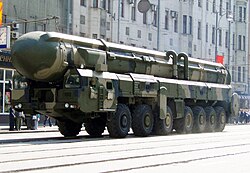
![The combat railway missile complex [ru] on display in Saint Petersburg, 2007](/images/c9/0e/c90e7afff2935e16f676095113fff90b4d52cda87c5c711ccb18af7cc8c29786.jpg)
The Commercial Era: Glavkosmos and Perestroika
During the late 1980s, the perestroika reform movement led to a shift toward commercialization. The ministry's agency, Glavkosmos, began offering launch services to international customers to compete with American providers. This effort was highlighted at the Space Commerce '88 trade show in Montreux, Switzerland.
Glavkosmos offered a diverse range of launchers tailored to different orbital needs:
- Energia: Capable of delivering up to 100 tons to Low Earth orbit (LEO).
- Proton: Capable of 20 tons to LEO or 2 tons to geostationary orbit, priced between US$25 million and US$30 million.
- Tsyklon-3: Designed for payloads up to 4 tons to LEO.
- Soyuz family: Configured for LEO, geostationary transfer, and Molniya orbits.
- Vostok: Priced between US$12 million and US$18 million.
The agency also marketed Kosmos rockets—which successfully launched India's Aryabhata and Bhaskara satellites—as well as Okean-O1 satellites and research space on the Foton satellites and Mir space station. These efforts resulted in several contracts, including microgravity experiments with Kayser-Threde and protein crystallization studies with Payload Systems Inc. on the Mir station.
Late-Stage Projects and Liquidation
One of the ministry's most ambitious endeavors was the Buran program, aimed at creating reusable spacecraft. Managed jointly with the Ministry of Aviation Industry, the program was marked by inter-ministerial disputes. Despite these tensions, the Buran spacecraft successfully completed its sole flight in November 1988.
The ministry's final major project was a 1991 agreement with the Indian Space Research Organisation (ISRO) valued at US$120 million. This deal involved the transfer of two KVD-1 engines and the design specifications necessary for India to build the engines indigenously for its Geosynchronous Satellite Launch Vehicle. However, the United States objected, citing a violation of the Missile Technology Control Regime (an informal political understanding among countries to limit the proliferation of missile technology). Due to resulting US sanctions, Russia backed out of the deal in 1993, forcing ISRO to develop its own cryogenic engine.
Summary of Glavkosmos Launch Offerings
| Launcher | Max Payload (LEO) | Other Capabilities/Price |
|---|---|---|
| Energia | 100 tons | Heavy lift |
| Proton | 20 tons | 2 tons to geostationary; US$25M–$30M |
| Tsyklon-3 | 4 tons | LEO delivery |
| Vostok | Not specified | US$12M–$18M |
| Soyuz | Various | LEO, Geostationary transfer, Molniya orbits |
Institutional Recognition
Throughout its history, the ministry incentivized performance and innovation through three specific awards: the "Excellence in Socialist Competition" (1955–1957), the "Best Innovator" (awarded during the 1970s), and the "Best Inventor" (awarded until 1991).
Frequently Asked Questions
What was the primary role of the Ministry of General Machine-Building?
The ministry was responsible for the development and management of Soviet space technology and liquid-fueled intercontinental ballistic missiles (ICBMs).
Did the ministry handle all types of missiles?
No. It focused on liquid-fueled missiles; solid-fueled missiles were developed by the Moscow Institute of Thermal Technology under the Ministry of Defense Industry.
What was Glavkosmos?
Glavkosmos was an agency within the ministry that began offering commercial satellite launch services to global customers during the perestroika era of the late 1980s.
Why was the agreement between Glavkosmos and ISRO cancelled?
The United States objected to the transfer of KVD-1 engine technology, claiming it violated the Missile Technology Control Regime, and subsequently imposed sanctions, leading Russia to withdraw from the deal in 1993.
What was the outcome of the Buran program?
Despite disputes between the Ministry of General Machine-Building and the Ministry of Aviation Industry, the Buran spacecraft successfully completed one flight in November 1988.