
Nalgene Outdoor: From Laboratory Equipment to Wilderness Essential
The transition of Nalgene products from sterile laboratories to the rugged backcountry is a unique story of organic adoption. In the 1970s, as conservationists and regulations began to discourage the disposal of glass and metal cans in wilderness areas, backpackers sought more secure, lightweight alternatives for storing food and liquids. They found the answer in high-density polyethylene (HDPE) and polycarbonate containers originally designed for scientific use.
This shift was solidified when Marsh Hyman, president of the Nalge Company in Rochester, New York, noticed his son's Boy Scout troop using laboratory containers during camping trips. Recognizing a market opportunity, the company began repackaging and marketing these items specifically for consumer use under the Nalgene Outdoor line.
Key Facts
- Laboratory Roots: Originally sold as lab equipment, Nalgene bottles are known for their durability and precise volume markings in milliliters.
- Material Variety: Products are available in HDPE, polycarbonate, and low-density polyethylene (LDPE).
- Temperature Resistance: Most standard Nalgene bottles can be filled with boiling water, though LDPE "bike" bottles cannot.
- Versatility: The wide-mouth design is preferred in sub-freezing conditions for easier ice removal.
- Eco-Friendly History: Popularized as a sustainable alternative to disposable cans and glass in the 1970s.
The Classic Water Bottle Lineup
By the late 1990s, the Nalgene trademark became a staple among hikers. The most iconic product is the 1-litre wide-mouth bottle made of translucent polycarbonate. While originally grey, these are now available in a vast array of bright colors and custom retail labels. A key design feature is the screw-on plastic top that remains attached to the bottle when open, preventing loss in the field.
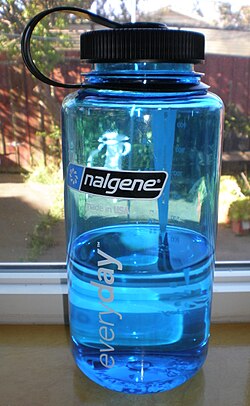
Nalgene currently offers over twelve different sizes, including both Wide Mouth and Narrow Mouth options. These materials are specifically chosen because they resist odors and stains. The wide-mouth variety is particularly favored by winter campers, as the larger opening makes it simpler to break through ice that may form inside the bottle.
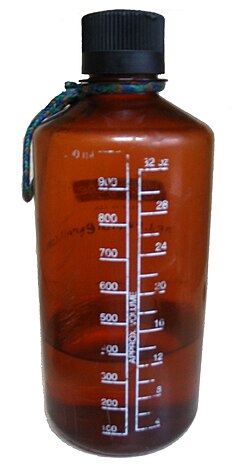
The All-Terrain Bike Bottle
For cyclists and active users, Nalgene offers a 650 ml (22 fl oz) "All-Terrain" bottle. Unlike the heavy-duty polycarbonate models, this bottle is made from low-density polyethylene (LDPE). It features a specialized screw top with a drinking nozzle that seals until pulled open, protected by a hinged polycarbonate dome to prevent contamination. Users should note that this specific model can be damaged by very hot water.
Expanding the Ecosystem: Accessories and Hydration
The popularity of the 2.5-inch neck and standard dimensions has led to a wide range of compatible third-party accessories. These additions transform a simple bottle into a multi-functional tool kit:
- Water Purification: Screw-on filters for cleaning water on the go.
- Cooking and Dining: Stainless-steel collapsible-handle cups that nest around the 1-litre bottle.
- Protection: Insulated nylon cases with attachment points and cup nesting.
- Convenience: Plastic "splash guards" to reduce spilling while drinking in motion.
- Brewing: Screw-in filters for steeping coffee or tea with boiling water.
- Lighting: Screw-on LED lights that convert the bottle into a low-power lantern.
Modern Hydration Systems
To compete in the modern outdoor market, Nalgene introduced hydration bladders ranging from 1 to 3 litres. These are housed in small back-carried packs (typically under 16 L or 1000 cubic inches). To address common issues like leaking and difficult filling, these systems feature self-sealing connectors that allow the bladder to be quickly detached from the hose and pack. Customers can choose between two materials: one optimized for taste and bacteria resistance, and another for maximum durability.
From the Trail to the City
While rooted in wilderness travel, Nalgene bottles have migrated into urban environments. Increased awareness of hydration has made them common sights in offices, gyms, and on college campuses. Many universities provide customized Nalgene bottles to students, and the brand continues to evolve, such as with the launch of a new color line in October 2017.
| Bottle Type | Primary Material | Key Feature | Boiling Water Safe? |
|---|---|---|---|
| Wide Mouth (1L) | Polycarbonate / HDPE | Easy ice removal; high durability | Yes |
| Narrow Mouth | Polycarbonate / HDPE | Compact drinking opening | Yes |
| All-Terrain (650ml) | LDPE | Hinged dome and pull-nozzle | No |
| Hydration Bladder | Variable Materials | Self-sealing connector; hose-valve | No |
Frequently Asked Questions
Can I put boiling water in all Nalgene bottles?
No. While the classic Wide Mouth and Narrow Mouth bottles are designed to handle boiling water, the 650 ml All-Terrain (bike) bottle made of LDPE can be damaged or ruined by very hot water.
Why is the wide-mouth bottle better for cold weather?
The wider opening makes it significantly easier for the user to break through and remove ice that may accumulate inside the bottle in sub-freezing conditions.
What are the benefits of the Nalgene hydration bladder system?
The system features a self-sealing connector that allows the bladder to be detached from the pack and hose quickly, which helps prevent leaks into other gear and makes filling the bladder easier.
What materials are used in Nalgene Outdoor products?
Nalgene uses high-density polyethylene (HDPE), polycarbonate, and low-density polyethylene (LDPE), depending on the specific bottle's intended use and required durability.
Are there accessories that fit Nalgene bottles?
Yes, many manufacturers create products for the 2.5-inch neck, including water filters, collapsible cups, insulated cases, splash guards, coffee filters, and LED lanterns.