
Neutral Beam System Design for Fusion Plasmas
Neutral Beam Injection (NBI) is a critical technology used to heat fusion-relevant plasmas to the extreme temperatures required for nuclear fusion. By injecting high-energy neutral atoms into a plasma, energy is transferred to the plasma core, sustaining the conditions necessary for fusion reactions. The design of these systems involves complex physics, from calculating the penetration depth of the beam to the sophisticated process of converting charged ions into neutral particles.
Beam Energy and Plasma Penetration
The effectiveness of a neutral beam depends on its ability to reach the center of the plasma rather than being absorbed at the edge. This is determined by the absorption length (λ), which represents the distance a neutral particle travels before being ionized. The absorption length is calculated using the formula:
λ = E / (18 · n · M)
In this equation, λ is measured in meters, particle density (n) in 10 m, atomic mass (M) in atomic mass units (amu), and particle energy (E) in keV. For fusion-relevant plasmas, the required energy for fast neutrals typically reaches the 1 MeV range to ensure sufficient power deposition in the plasma core.
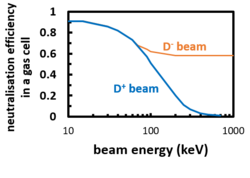
As energy requirements increase, producing fast hydrogen atoms from positive-ion beams becomes increasingly difficult. Consequently, modern and future heating systems utilize negative-ion beams. It is significantly easier to detach an extra electron from a negative ion—which has a binding energy of 0.75 eV and a large detachment cross-section—than it is to attach an electron to a positive ion.
The Precursor Ion Beam
A neutral beam begins as a precursor ion beam, typically accelerated via large electrostatic accelerators. These beams are generated by extracting charges from a plasma discharge. While positive ions are readily available, negative hydrogen ions are rare in standard hydrogen plasma discharges.
To overcome this, surface-plasma negative-ion sources are used. These sources introduce caesium vapors into the plasma discharge. Caesium acts as an efficient electron donor when deposited on the source walls; atoms and positive ions that scatter off these caesiated surfaces have a higher probability of becoming negatively charged ions. Despite their effectiveness, caesiated sources are complex and lack high reliability, driving the need for alternative negative-ion beam source concepts for future reactors.
Comparison of Negative-Ion-Based Systems (N-NBI)
Several major projects have implemented or planned negative-ion-based neutral beam systems to achieve the necessary power and energy levels.
| System | Precursor Ion Beam | Max Acceleration Voltage (kV) | Max Power per Beam (MW) | Pulse Duration (s) |
|---|---|---|---|---|
| JT-60U | D | 400 | 5.8 | 30 (at 2MW, 360kV) |
| LHD | H / D | 190 | 6.4 | 128 (at 0.2MW) |
| ITER | D | 1000 | 16.7 | 3600 (at 16.7MW) |
Ion Beam Neutralisation
To enter the plasma, the precursor ion beam must be neutralised, typically by passing it through a gas cell. For negative-ion beams at fusion energies, several collisional processes occur:
- Single-electron detachment: D- + D2 → D + e + D2
- Double-electron detachment: D- + D2 → D+ + 2e + D2
- Reionization: D + D2 → D+ + e + D2
- Charge exchange: D+ + D2 → D + D2+ (negligible at 1 MeV)
At 1 MeV, the cross-sections (the probability of a collision occurring) are such that once a particle becomes a positive ion, it cannot easily be converted back into a neutral atom. This limitation restricts the overall efficiency of gas neutralisers.
Gas Cell Dynamics and Engineering
The efficiency of the neutraliser depends on the target thickness (τ), which is the integrated gas density along the beam path. For Deuterium (D) beams at 1 MeV, the maximum neutralisation yield occurs at a target thickness of approximately 1.4 · 10-16 m.
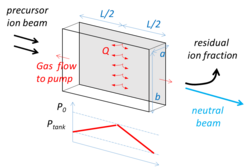
To prevent beam loss, background gas density is kept to a minimum everywhere except inside the neutraliser cell. This is achieved by injecting gas into a cell with two open ends, creating a peaked density profile at the center. The maximum pressure (P0) at the center is determined by the gas throughput (Q) and the gas conductance (C), calculated as:
P0 = Ptank + Q / 2C
Because of the high gas throughput required, these systems utilize some of the largest vacuum pumps ever constructed, with pumping speeds reaching millions of liters per second. While longer cells (L) generally improve performance—such as the 15m cell in JT-60U—future devices like ITER are limited by the space available within the neutron-shielding bioshield, restricting cell lengths to approximately 3m.
Key Facts
- Energy Requirement: Fusion-relevant plasmas typically require neutral beam energies in the 1 MeV range for core penetration.
- Ion Choice: Negative-ion beams are preferred over positive-ion beams at high energies due to the ease of electron detachment.
- Source Enhancement: Caesium vapors are used in surface-plasma sources to increase the production of negative hydrogen ions.
- Neutralisation Limit: At 1 MeV, the inability to convert fast positive ions back into neutrals limits gas cell efficiency.
- Vacuum Demands: NBI systems require massive vacuum pumps with speeds in the millions of liters per second to manage gas throughput.
Frequently Asked Questions
Why are negative-ion beams used instead of positive-ion beams?
At the high energies required for fusion (around 1 MeV), it is much more efficient to remove an electron from a negative ion (detachment) than to add one to a positive ion (attachment) to create a neutral atom.
What is the role of caesium in negative-ion sources?
Caesium is deposited on the walls of the plasma discharge source to act as an electron donor. This increases the probability that atoms or positive ions scattering off the surface will emerge as negative ions.
What limits the efficiency of a gas-cell neutraliser?
The primary limit is that at high energies (1 MeV), the cross-section for converting a fast positive ion back into a neutral atom is negligible. Once a particle is reionized to a positive state, it cannot be neutralised.
How does the bioshield affect neutral beam design?
The bioshield protects the facility from energetic neutron flux but limits the physical space available. This forces a reduction in the length of the neutraliser gas cell, as seen in ITER where the length is limited to 3 meters compared to 15 meters in JT-60U.
What is target thickness in the context of neutralisation?
Target thickness (τ) is the integrated gas density along the path of the ion beam. It is a critical parameter because the maximum neutralisation yield occurs only at a specific target thickness.