
Nickel: Properties, Industrial Applications, and Chemical Characteristics
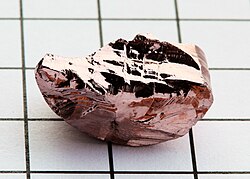
Nickel is a lustrous, silver-white transition metal with a subtle golden tinge. Known for its strength and resistance to corrosion, it plays a critical role in modern engineering and chemistry. From the coins in our pockets to the high-performance alloys used in aerospace, nickel is a cornerstone of industrial metallurgy.
The element was first isolated in 1751 by Axel Fredrik Cronstedt. Its name is derived from Nickel, a mischievous mine spirit in German mythology, reflecting the challenges early miners faced when encountering this metal in ores that resembled copper.

Key Facts
![Electron micrograph of a Ni nanocrystal inside a single wall carbon nanotube; scale bar 5 nm[19]](/images/49/bc/49bc8e6818f79b4a72ca3868b6955d0ae32f2809aecbe124315f2cd49f390ed2.jpg)
- Atomic Number: 28
- Atomic Weight: 58.6934 ± 0.0004 u
- Magnetic Property: Ferromagnetic
- Crystal Structure: Face-centered cubic (fcc)
- Common Oxidation States: +2, -2, -1, 0, +1, +3, +4
- Primary Use: Engineering and stainless steel production
Physical and Atomic Properties
![Structure of [Ni2(CN)6]4− ion[44]](/images/db/2e/db2e39e1752574988a9620ff2f0c0d9efb5876b6f5072f8f60aabf4d003599c1.png)
Nickel is located in Group 10 and Period 4 of the periodic table, belonging to the d-block. It is a solid at standard temperature and pressure (STP) with a high melting point of 1728 K (1455 °C) and a boiling point of 3003 K (2730 °C). Its density at 20 °C is 8.907 g/cm³.
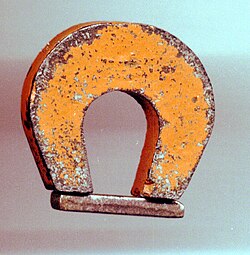
One of nickel's most defining physical characteristics is its ferromagnetic nature, meaning it can be permanently magnetized. This property makes it invaluable for creating strong magnets, often when alloyed with other metals.
Atomic Specifications
The electron configuration of nickel is [Ar] 3d⁸ 4s² (or [Ar] 3d⁹ 4s¹). It has an empirical atomic radius of 124 pm and a Pauling electronegativity of 1.91. In terms of hardness, it registers 4.0 on the Mohs scale.
Isotopes and Occurrence
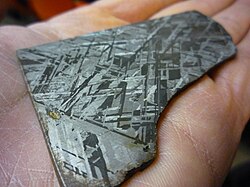
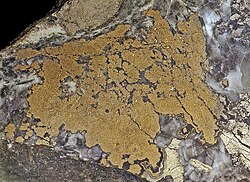
Nickel occurs naturally as a primordial element. While it is found in various ores, it is also famously present in meteorites. The Widmanstätten pattern, characterized by the intersection of kamacite and taenite (nickel-iron alloys), is a hallmark of octahedrite meteorites.
At least 26 radioisotopes of nickel have been characterized. The most abundant stable isotopes are Ni-58 (68.1%) and Ni-60 (26.2%). Among the radioisotopes, Ni-63 is one of the most stable, with a half-life of approximately 100 years.
Chemical Compounds and Reactivity
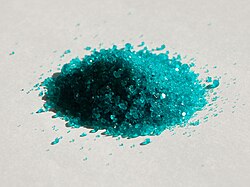
Nickel exhibits a wide range of oxidation states, with +2 being the most common. Its chemistry is diverse, ranging from simple salts to complex organometallic compounds.
- Nickel(0): Tetracarbonyl nickel, Ni(CO)₄, is a volatile compound used in the purification of the metal.
- Nickel(II): This state forms various colorful aqueous complexes, such as [Ni(H₂O)₆]²⁺.
- Higher Oxidation States: Nickel(III) and Nickel(IV) are less common but exist in specific complexes and compounds like nickel(III) antimonide.

![Color of various Ni(II) complexes in aqueous solution. From left to right, [Ni(NH3)6]2+, [Ni(NH2CH2CH2NH2)3]2+, [Ni(H2O)5Cl]+, [Ni(H2O)6]2+](/images/f8/fb/f8fb7579e2f35131087bf67fe967a2e572b200fd504738f437b02681a5e26d00.jpg)
Industrial Production and Applications
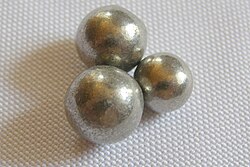
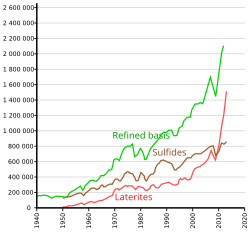
Nickel is extracted from various ores, with production trends evolving over time to meet global demand. One of the most significant methods for producing high-purity nickel is the Mond process, which involves the reaction of nickel with carbon monoxide to form a gas that is subsequently decomposed to yield pure nickel spheres.
Market Distribution
Nickel is utilized across a broad spectrum of industries. The distribution of its use is as follows:
| Sector | Percentage of Production |
|---|---|
| Engineering | 27% |
| Metal Goods | 20% |
| Tubular Products | 14% |
| Transport | 14% |
| Building and Construction | 10% |
| Electronic Goods | 11% |
| Other Uses | 5% |
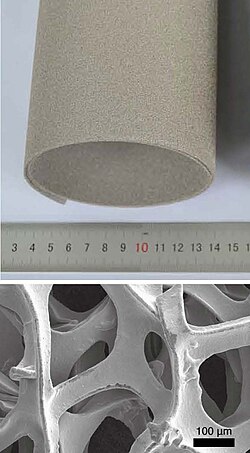
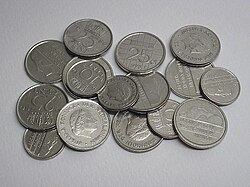
Beyond general engineering, nickel is used in the creation of nickel foam for specialized internal structures and in the minting of coins in various countries.
Biological Role and Toxicity
While nickel has some biological roles in microorganisms, it can be toxic to humans. It is a well-known contact allergen, often causing skin reactions when people come into contact with nickel-containing jewelry or coins.
From a safety perspective, certain nickel compounds are classified as dangerous. The NFPA 704 diamond for nickel indicates specific hazards, and some compounds are recognized as potential carcinogens (H351) or toxic to aquatic life (H412).

Frequently Asked Questions
![Time trend of nickel production[77]](/images/ef/40/ef40974efd1694e1cf49637dc57e1ac30d589bcc43b059a0ce60b2539efcf80d.webp)
What is the Mond process?
The Mond process is a chemical technique used to refine nickel. It involves reacting impure nickel with carbon monoxide to create nickel tetracarbonyl gas, which is then heated to decompose the gas back into highly purified nickel metal.
Is nickel magnetic?
Yes, nickel is one of the few elements that is ferromagnetic at room temperature, meaning it can be magnetized and attract other ferromagnetic materials.
Why is nickel used in stainless steel?
Nickel is added to steel to improve its corrosion resistance and ductility, making the resulting stainless steel more durable and resistant to rust.
What are the health risks associated with nickel?
The most common health risk is nickel allergy, which manifests as dermatitis. Additionally, some nickel compounds are classified as carcinogens and can cause respiratory issues if inhaled in industrial settings.
Where is nickel found in nature?
Nickel is found in the Earth's crust in various ores and is also a significant component of iron-nickel alloys found in meteorites, which often display the Widmanstätten pattern.