
Our Lady's Church: A History of Resilience and Architecture in Frankfurt
The story of the church dedicated to Mary, known as "Unsere liebe Frau," is a testament to the enduring spiritual and architectural heritage of Frankfurt. From its humble beginnings as a private family chapel to its role as a collegiate church, the site has evolved through centuries of stylistic shifts, religious upheavals, and the devastation of war.
The Early Foundations and Gothic Expansion
The site's religious significance began in 1325 when the archbishop of Mainz, Matthias von Buchegg, elevated a family chapel to the status of a collegiate church. This established it as the third collegiate church in the town, following the foundations of St. Leonhard (1317) and St. Bartholomew, which was attached to the Frankfurt Cathedral.
By 1344, the structure underwent a significant transformation into a Gothic hall church—a design characterized by naves of approximately equal height—consisting of three naves. Historical records of its consecration note the presence of two altars during this period.
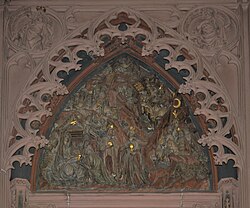
Architectural refinements continued into the 15th century. Starting in 1415, the south facade was redesigned to include a tympanum (the semi-circular decorative wall surface over an entrance) depicting the Adoration of the Magi, crafted by the workshop of Madern Gerthener.
Further expansions occurred between 1506 and 1509 under the direction of Jörg Östereicher. Additionally, in 1453, the town council authorized the conversion of a nearby fortification tower into a dedicated bell tower.
Religious Continuity and Baroque Transformation
Despite the introduction of the Reformation in Frankfurt in 1533, the church remained Catholic and continued to be part of the Diocese of Mainz. This continuity allowed the building to undergo a major aesthetic shift between 1763 and 1771, during which it was partially converted to the Baroque style.
During this era, the interior was almost entirely redesigned. Mainz workshops installed a new chancel and five new altars. The tower's helmet was also replaced with the version that remains visible today. To complement the visual splendor, an organ built by Frankfurt craftsman Ernst Weegmann was installed in 1763.
Secularization, War, and Modern Restoration
The 19th century brought administrative changes; following the secularization of 1803, ownership of the church passed to the city of Frankfurt. In 1824, Friedrich Rumpf constructed a new entrance specifically designed to protect the historic tympanum. The musical legacy of the church continued with the installation of a Walcker organ in 1864.
In 1923, the Capuchins assumed spiritual leadership of the church and established a convent to the north of the building. However, this period of stability was shattered in 1944 when bombing during World War II completely destroyed the church. Only a few fragments of the statue of Mary and the high altar survived the ruins.
The church was restored during the 1950s. While the building was returned to use, it was done so in a simplified form, where the original Gothic vaults were replaced with wooden ceilings.
Key Facts
- Founded: Established as a collegiate church in 1325.
- Architectural Styles: Transitioned from Gothic hall church to Baroque and finally to a simplified post-war restoration.
- Key Artwork: Features a tympanum of the Adoration of the Magi by Madern Gerthener's workshop.
- Religious Affiliation: Remained Catholic under the Diocese of Mainz throughout the Reformation.
- Major Loss: Completely destroyed by bombing in 1944, with only minimal fragments saved.
| Period/Year | Key Event or Change | Primary Influence/Figure |
|---|---|---|
| 1325 | Family chapel becomes collegiate church | Matthias von Buchegg |
| 1344 | Expansion to three-nave Gothic hall church | Gothic Architecture |
| 1415 | South facade and tympanum added | Madern Gerthener Workshop |
| 1763–1771 | Baroque interior and tower helmet update | Mainz Workshops / Ernst Weegmann |
| 1803 | Ownership transferred to Frankfurt | Secularization |
| 1944 | Total destruction by bombing | World War II |
| 1950s | Simplified restoration with wooden ceilings | Post-war Reconstruction |
Frequently Asked Questions
When was the church first established?
The site began as a family chapel and was officially made a collegiate church in 1325 by the archbishop of Mainz, Matthias von Buchegg.
What happened to the church during the Reformation?
While the Reformation was introduced in Frankfurt in 1533, the church remained Catholic and stayed under the jurisdiction of the Diocese of Mainz.
What is the significance of the tympanum?
The tympanum is a decorative architectural element on the south facade showing the Adoration of the Magi, created by the workshop of Madern Gerthener starting in 1415.
How was the church affected by World War II?
The church was completely destroyed by bombing in 1944. The only items saved from the destruction were fragments of the statue of Mary and the high altar.
How does the current building differ from the original Gothic structure?
The 1950s restoration was simplified; most notably, the original Gothic vaults were not rebuilt and were instead replaced by wooden ceilings.