
Podgorica Airport: Infrastructure, Operations, and History
Podgorica Airport serves as a vital gateway to Montenegro, balancing civilian aviation needs with a complex military history. From its single-terminal layout to its unique geographical approach, the airport provides essential connectivity despite operating under significant pressure during peak travel seasons.
Key Facts
- Terminal Capacity: Designed for 1 million passengers annually; operating beyond capacity since 2017.
- Runway Specs: A single 2,500-meter runway (18/36) with a parallel taxiway.
- Flight Approach: Runway 36 features a dramatic 200° right turn over Lake Skadar.
- Parking: Publicly accessible lot accommodating 300 vehicles.
- Military Legacy: Former home to the Šipčanik underground aircraft shelter.
Passenger Terminal Facilities
The current passenger terminal, in operation since May 14, 2006, is a single-level facility spanning 7,900 square meters (85,000 sq ft). The terminal is designed to streamline the flow of travelers through a specific set of checkpoints and gates.
The facility includes 8 check-in counters and two departure lanes, each consisting of boarding ticket checkpoints, border control, and security checkpoints. For departures and arrivals, the airport utilizes 8 departure gates, 2 arrival gates, and 6 arrival border checkpoints. Baggage is handled via two claim conveyors.
Unlike many international hubs, the terminal does not feature jet bridges. Passengers typically walk to their aircraft, though airport buses are deployed during heavy rainfall or peak summer traffic. Mobile stairs are used for all boarding and deplaning processes. While the original terminal building still exists, it has been repurposed for administrative functions and is closed to the public.
Runway and Flight Operations
The airport operates a single runway, designated 18/36, which is perfectly aligned north to south. Measuring 2,500 meters (8,200 ft) in length and 45 meters (148 ft) in width, the runway is supported by a parallel taxiway that runs its entire length.
Technically, the airport holds an ICAO classification 4E with ILS Cat I (Instrument Landing System Category I), a system that provides precision guidance to pilots during approach. However, ILS landings are only available on runway 36. The northern approach to runway 18 is restricted to visual-only landings under perfect VMC (Visual Meteorological Conditions) due to the proximity of the Dinaric Alps.
One of the most notable aspects of the airport's operation is the approach to runway 36. Airliners perform a spectacular 200° right turn at an altitude of 530 meters (1,740 ft) above the surface of Lake Skadar to align with the runway.
Military History and the Šipčanik Complex
Podgorica Airport shares its runway with the Montenegrin Air Force Podgorica Airbase. Historically, the site featured the Šipčanik complex, an underground aircraft shelter tunneled into a hill. This complex was connected to the main runway by a 6-kilometer (20,000 ft) taxiway, with a wider northern section designed to allow jets to scramble quickly during emergencies.
Because the Montenegro Air Force does not operate fixed-wing aircraft, the Šipčanik complex was decommissioned and converted for civilian use in the early 2000s.
The airbase was a frequent target during the NATO bombing of Yugoslavia. While the terminal and runway remained untouched, the military infrastructure and equipment suffered severe damage.
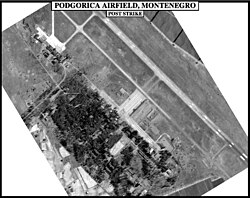
The airport also played a role in regional political tensions. On December 9, 1999, a standoff occurred between the Yugoslav Army and Montenegro security forces as the two entities struggled for control over the airport.
Airport Specifications Summary
| Feature | Detail |
|---|---|
| Terminal Floor Area | 7,900 m² (85,000 sq ft) |
| Annual Design Capacity | 1,000,000 passengers |
| Runway Dimensions | 2,500m x 45m |
| ICAO Classification | 4E |
| Parking Capacity | 300 vehicles |
| Landing Systems | ILS Cat I (Runway 36 only) |
Frequently Asked Questions
Does Podgorica Airport have jet bridges?
No, the terminal does not have jet bridges. Passengers use mobile stairs to board and deplane, and typically walk to the aircraft, though buses are used during peak summer traffic or rain.
Why is the approach to runway 18 limited?
The northern approach to runway 18 is visual-only and requires perfect Visual Meteorological Conditions (VMC) because of the proximity of the Dinaric Alps.
What is the Šipčanik complex?
The Šipčanik complex was an underground military aircraft shelter tunneled into a hill, connected to the runway by a 6-kilometer taxiway. It was decommissioned in the early 2000s.
Is the airport currently overcrowded?
Yes, the terminal has been operating beyond its designed capacity of one million passengers per year since 2017, with the most extreme overcrowding occurring during the summer peak.
What happens during a standard approach to runway 36?
Airliners perform a 200° right turn approximately 530 meters above Lake Skadar to align themselves with the runway.