
Portland International Jetport: A Comprehensive History of PWM
The Portland International Jetport (PWM) serves as a vital gateway to Maine, evolving from a modest private airfield into a modern transportation hub. Its journey reflects the broader trajectory of American aviation, moving from the era of biplanes and gravel strips to the age of international jet travel and sustainable infrastructure.
Early Years and Foundation
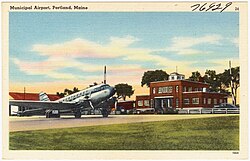
The airfield was established in the late 1920s by Dr. Clifford "Kip" Strange to accommodate his JN-4 "Jenny" Biplane. Originally known as Stroudwater Airport, the site entered the commercial arena on August 1, 1931, with the introduction of Boston-Maine Airways flights between Portland and Boston.
In 1937, the city of Portland purchased the airfield for $68,471, renaming it the Portland-Westbrook Municipal Airport. The "Westbrook" portion of the name referred to a directional light located in the nearby city of Westbrook, and this naming convention provided the origin for the airport's current code, PWM.
During the 1930s, the airport benefited significantly from New Deal public works programs. Between April 1934 and July 1935, the Maine Emergency Relief Administration (MERA) spent $816,376 on statewide airport labor, which included constructing two gravel runways at Portland: a north-south strip (2,400' x 100') and an east-west strip (1,500' x 100'). Later, the Works Progress Administration (WPA) further developed the site, building the city's first brick terminal in 1940, which continues to serve as the general-aviation terminal today.
The Transition to the Jet Age
The mid-20th century saw a rapid expansion of infrastructure to meet growing demand. By 1951, the airport operated three runways, and by 1966, Runway 11/29 had been extended to 6,800 feet. The current terminal opened in 1968, coinciding with the arrival of jet service.
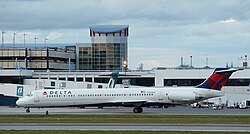
For years, Northeast Airlines held a monopoly on commercial travel in Portland. While Atlantic Airways briefly attempted to compete in 1962, Northeast remained the dominant carrier until 1970. The introduction of DC-9 jets in 1968 marked a milestone, providing Portland's first non-stop service beyond Boston to New York City's LaGuardia Airport.
The landscape shifted in 1972 when Delta Air Lines acquired Northeast Airlines, maintaining routes to Boston, New York, and Bangor, and later adding Burlington, Vermont, by 1979.
Growth and Competition (1980s – 1990s)
The 1980s brought a wave of new competitors and facility upgrades. The passenger terminal expanded in 1980, adding baggage carousels to the east and second-level jetways to the west. In 1982, Delta briefly introduced non-stop flights to Cincinnati using Boeing 727 aircraft.
The arrival of People Express Airlines in 1983 introduced the concept of low-cost carriers to the Jetport, offering budget-friendly flights to Newark. This era also saw the arrival of United Airlines in 1983 and USAir in 1986, the latter providing connections to Philadelphia and Pittsburgh. Other short-lived carriers, such as Presidential Airways and Air Vermont, also operated during this period.
By 1995, a major improvement project added two second-level boarding gates and an international customs facility to accommodate growing passenger volumes and operational needs.
Modern Era: Challenges and Expansion
The events of September 11, 2001, had a profound impact on the Jetport. Two of the hijackers of American Airlines Flight 11 had traveled from Portland to Boston via Colgan Air Flight 5930 that morning. In the aftermath, security protocols tightened, and many airlines shifted from mainline jets to smaller regional aircraft or turboprops.
Despite these challenges, the 2000s saw a resurgence of competition. JetBlue entered the market in 2006, triggering the "Southwest Effect," where the influx of low-cost seats forced competing airlines to lower their fares. AirTran Airways followed in 2007, introducing the first scheduled non-stop flights to Florida.
In 2008, Delta Air Lines resumed mainline service with McDonnell Douglas MD-88 flights to Atlanta (later replaced by Airbus A319s in 2020). International service also fluctuated, with Starlink Aviation and Air Canada providing connections to Nova Scotia and Toronto between 2009 and 2013.
Infrastructure and Sustainability
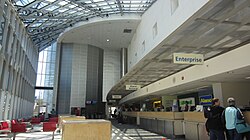
A massive $75 million terminal expansion project took place between 2010 and 2011. Designed by Gensler and built by Turner Construction, the project improved security, check-in areas, and parking. Notably, the terminal implemented a geothermal heating and cooling system—the largest in Maine—reducing heating oil consumption by up to 102,000 gallons annually.
Most recently, in April 2024, the Jetport began upgrading taxiway lights and reconfiguring Taxiway A and the new Taxiway A4 to comply with FAA regulations and improve safety during aircraft push-backs from terminal gates.
Key Facts
- Founded: Late 1920s by Dr. Clifford "Kip" Strange.
- Airport Code: PWM (derived from the nearby city of Westbrook).
- First Commercial Flight: August 1, 1931 (Boston-Maine Airways).
- Major Expansion: $75 million terminal upgrade completed in 2011.
- Sustainability: Features Maine's largest geothermal heating and cooling system.
- Key Carriers: Historically served by Northeast, Delta, JetBlue, and United.
| Period/Year | Key Event | Impact/Detail |
|---|---|---|
| 1931 | First Commercial Service | Boston-Maine Airways begins Portland-Boston route. |
| 1937 | City Acquisition | Portland purchases airfield for $68,471. |
| 1968 | Jet Age Arrival | New terminal opens; non-stop flights to NYC begin. |
| 1983 | Low-Cost Entry | People Express introduces budget air travel. |
| 2006 | JetBlue Arrival | Significant fare reduction due to increased low-cost capacity. |
| 2011 | Terminal Expansion | $75 million upgrade with geothermal system. |
| 2024 | Taxiway Upgrades | Modernization of lighting and FAA safety compliance. |
Frequently Asked Questions
Why is the airport code PWM?
The code originates from the airport's former name, Portland-Westbrook Municipal Airport. "Westbrook" referred to the location of the final directional light before reaching the airport in the nearby city of Westbrook.
What is the "Southwest Effect" mentioned in the airport's history?
The Southwest Effect refers to the economic phenomenon where the entry of a large low-cost carrier (such as JetBlue in 2006) into a market forces existing competitors to lower their ticket prices to remain competitive.
How does the airport incorporate green energy?
The terminal expansion completed in 2011 included the installation of a geothermal heating and cooling system, which is the largest of its kind in Maine and saves approximately 102,000 gallons of heating oil per year.
Who was the airport almost named after in 1982?
The Portland City Council briefly renamed the Jetport for longtime senator Edmund Muskie, but the decision was reversed three weeks later following public outcry and a request from Muskie himself.
What recent infrastructure changes were made in 2024?
The airport upgraded taxiway lights on Taxiway A, replaced old edge lights with reflectors, added centerline lights, and constructed Taxiway A4 to meet FAA regulations regarding aircraft push-backs.