
Skidel: A History of Political Transition and Tragedy
The town of Skidel (historically referred to as Skidzyel’) has served as a crossroads of empires and ideologies for centuries. From its early days within the Grand Duchy of Lithuania to its role as a Soviet administrative hub, the town's trajectory reflects the turbulent geopolitical shifts of Eastern Europe.
Early Governance and Demographic Shifts
Originally part of the Trakai Voivodeship within the Grand Duchy of Lithuania, Skidel underwent its first major political shift in 1795. Following the Third Partition of Poland, the town was acquired by the Russian Empire.
By the era of the Second Polish Republic (1921–1939), Skidel was integrated into the Białystok Voivodeship. During this period, the town functioned as a shtetl—a small town with a large Jewish population. According to the 1921 Polish census, the demographic makeup was predominantly Jewish (68.7%), followed by Polish (17.3%) and Belarusian (12.3%) residents.
The Outbreak of World War II and the Skidel Revolt
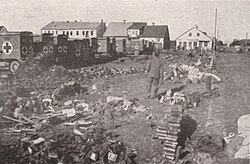
The onset of World War II brought immediate violence to the region. On September 18, 1939, during the Soviet invasion of Poland, a pro-Soviet communist revolt erupted. This uprising, known as the Skidel revolt, involved killing squads from the delegalized Communist Party of Western Belarus, who used smuggled Soviet weaponry to massacre ethnic Poles.
Although a unit of the Polish Army briefly restored control on September 19, the victory was short-lived. By September 20, the Red Army occupied the town. On November 14, 1939, Skidel was officially incorporated into the Byelorussian SSR.
Nazi Occupation and the Holocaust
The geopolitical landscape shifted again on June 27, 1941, when Nazi Germany occupied the town. Skidel was then administered as part of Bezirk Bialystok. This period was marked by systemic brutality, including frequent shootings of Jewish residents in nearby forests.
The local Jewish population was confined to a ghetto, which was liquidated on November 2, 1942. The prisoners were transported to the Kolbassino (Kiełbasin) Sammellager, a transit camp to the south. At its peak, this camp held between 22,000 and 28,000 people, including those from the Grodno Ghetto, before they were deported via Holocaust trains to the Auschwitz extermination camp.
Post-War Era and Soviet Administration
Following the conclusion of World War II, Skidel transitioned into a strategic administrative center for the Soviet regime. The Grodno headquarters of the Communist Party of the Soviet Union remained located in the town until the eventual collapse of the Soviet Union in 1991.
Key Facts
- 1795: Acquired by the Russian Empire after the Third Partition of Poland.
- 1921 Census: Jewish population comprised 68.7% of the town's residents.
- September 1939: Site of the Skidel revolt and subsequent Red Army occupation.
- 1941–1944: Occupied by Nazi Germany as part of Bezirk Bialystok.
- November 2, 1942: Date of the liquidation of the Skidel ghetto.
- Post-WWII: Served as the Grodno headquarters for the Communist Party of the Soviet Union until 1991.
| Period | Governing Entity | Administrative Unit |
|---|---|---|
| Early History | Grand Duchy of Lithuania | Trakai Voivodeship |
| 1795 – 1921 | Russian Empire | N/A |
| 1921 – 1939 | Second Polish Republic | Białystok Voivodeship |
| 1939 – 1941 | Soviet Union | Byelorussian SSR |
| 1941 – 1944 | Nazi Germany | Bezirk Bialystok |
| 1944 – 1991 | Soviet Union | Byelorussian SSR |
Frequently Asked Questions
What was the demographic composition of Skidel in 1921?
According to the 1921 Polish census, the population was 68.7% Jewish, 17.3% Polish, and 12.3% Belarusian.
What was the Skidel revolt?
The Skidel revolt occurred on September 18, 1939, when pro-Soviet communist squads, armed with smuggled Soviet guns, carried out a massacre of ethnic Poles during the Soviet invasion of Poland.
What happened to the Jewish population during the Nazi occupation?
Jewish residents were subjected to frequent shootings in nearby forests and confined to a ghetto. After the ghetto was liquidated on November 2, 1942, they were sent to the Kolbassino transit camp and subsequently to the Auschwitz extermination camp.
How many people were held at the Kolbassino transit camp?
The camp, which held Jews from both Skidel and the Grodno Ghetto, contained between 22,000 and 28,000 people.
What was Skidel's role after World War II?
After the war, Skidel hosted the Grodno headquarters of the Communist Party of the Soviet Union, maintaining this status until 1991.