
St Davids: The Sacred History of Wales' Smallest City
Nestled in the rugged landscape of Pembrokeshire, St Davids stands as a testament to the enduring spiritual and cultural heritage of Wales. Known in Ecclesiastical Latin as Menevia and in Welsh as Mynyw, this unique city evolved from a remote monastic cell into one of the most significant pilgrimage sites in the medieval world.
While the surrounding area contains evidence of Palaeolithic, Bronze Age, and Iron Age settlements, archaeological records suggest that the Romans did not heavily occupy the region. Early traditions suggest that before the arrival of Saint David, a church or monastery may have been founded by Saint Patrick around 470 AD.
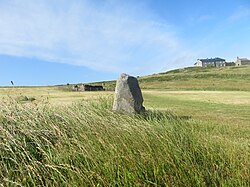
The Age of Saint David
The city's identity is inextricably linked to Saint David, born around 500 AD to Saint Non. Following his birth at the site of the current Chapel of St Non, David was baptised by Saint Elvis at Porthclais and raised at Llanon. Some accounts suggest he received an education from Saint Paulinus at "Ty Gwyn" in Whitesands.
David initially established a community to the west of the modern city before founding a church and monastery at "Glyn Rhosyn" on the banks of the Afon Alun. This site eventually became the location of the current Cathedral.
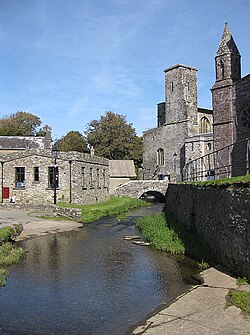
As a prominent figure in the Celtic church, David played a critical role in opposing the Pelagian Heresy (a theological belief regarding original sin and free will). In 545 AD, at the Synod of Brefi, Saint Dubricius granted David the Metropolitan See of Caerleon. This transfer likely included a royal court; the Welsh Triads identify Mynyw as one of the three Tribal Thrones of Britain, listing Arthur as Chief Prince, David as Chief Bishop, and Maelgwn Gwynedd as Chief Elder.
A Medieval Hub of Pilgrimage and Learning
The monastery, known as Tyddewi (House of David), grew into a world-renowned center of scholarship and faith. Its reputation was so prestigious that King Alfred the Great requested the services of Asserius Menevensis (Asser of St Davids), a scholar trained and ordained at the monastery, to join his court.
The cult of Saint David was further solidified by pre-Norman Bishops Sulien and Rhigyfarch, who authored the Vita sancti Davidis episcopi, the standard biography of the saint.
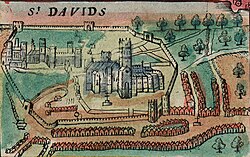
During the Norman period, the city became a marcher borough, and the surrounding area was named "Dewisland." The cathedral was rebuilt during the 12th century, retaining the layout of the earlier medieval structure and housing the remains of Saint David. The site's prestige reached such heights that Pope Calixtus II decreed that two pilgrimages to St Davids were equivalent to one pilgrimage to Rome.
This spiritual status attracted royalty, including William the Conqueror (1081), Henry II (1171), and Edward I and Queen Eleanor (1284), bringing vast wealth to the monastery, which officially became a Cathedral in the 12th century.
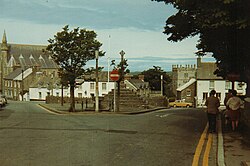
Decline and the Reformation
The prosperity of St Davids began to wane during the Reformation as pilgrimages lost favor. The appointment of English Bishops who lacked interest in the city's welfare accelerated this decline. A notable example was Bishop William Barlow, who in 1536 sold the lead from the roof of the Bishop's Palace and moved the chief residence to Abergwili, Carmarthenshire, in 1542.
By the 17th century, the Bishop's palace was considered beyond repair, and the city's infrastructure crumbled. By the 19th century, the Penny Cyclopaedia described the location as a "poor village" with ruinous houses, noting that only the Cathedral retained its former glory.
St Davids in the Modern Era
The 20th century brought a slow recovery. Following the disestablishment of the Church in Wales in 1920, the Cathedral Close operated as its own civil parish for 50 years, separate from the city.
Today, improved transport and the rise of tourism have revitalized the area. With 210 listed buildings, including the Bishop's Palace maintained by Cadw, St Davids is once again a destination for walkers, tourists, and modern pilgrims.
Key Facts
- Papal Decree: Pope Calixtus II ruled that two visits to St Davids equaled one visit to Rome.
- Royal Visitors: The city hosted William the Conqueror, Henry II, and Edward I.
- Ancient Names: Known as Menevia in Latin and Mynyw in Welsh.
- Architectural Heritage: The city currently boasts 210 listed buildings.
- Founding: Saint David established his monastery at Glyn Rhosyn on the Afon Alun.
| Period | Key Status/Event | Notable Figures |
|---|---|---|
| Early History | Monastic cell/Early church | Saint Patrick |
| Age of David | Establishment of monastery | Saint David, Saint Non |
| Medieval Era | Major pilgrimage center | Asser, William the Conqueror |
| Reformation | Economic and physical decline | Bishop William Barlow |
| Modern Era | Tourism and conservation | Cadw |
Frequently Asked Questions
Who was Saint David?
Saint David was a key figure in the Celtic church born around 500 AD. He founded a monastery at Glyn Rhosyn and served as the Chief Bishop of Mynyw, becoming the patron saint of Wales.
Why was St Davids so important in the Middle Ages?
It was a world-famous center of learning and a major pilgrimage site. Its importance was highlighted by a papal decree stating that two pilgrimages there were equal to one to Rome.
What caused the decline of the city?
The Reformation led to a drop in pilgrimage income. This was worsened by neglect from English Bishops, such as William Barlow, who sold materials from the Bishop's Palace.
What is the significance of the Afon Alun?
The Afon Alun is the river on whose banks Saint David founded his original church and monastery, the site where the current Cathedral now stands.
Is the Bishop's Palace still standing?
Yes, although it suffered a long period of neglect after the 16th century, it is now maintained by Cadw and is open to the public.