
Stanhope Forbes: Master of Cornish Genre and Plein Air Painting
Stanhope Forbes was a distinguished artist renowned for his ability to capture the raw, sincere essence of rural life. Specializing in genre scenes—paintings depicting scenes from everyday life—and landscapes, Forbes is best remembered for his commitment to en plein air painting, a technique where the artist works outdoors to capture the natural light and atmosphere of a location.
His work is characterized by a profound sense of sincerity and a lack of sentimentality. As noted by contemporary Norman Garstin, Forbes was a "good unsentimental painter" whose work possessed a universal appeal due to its honesty.
The Art of Light and Humanity
Forbes's mastery of light is evident in both his outdoor and indoor works. In his 1907 piece, After a Day's Work, he provides a vivid snapshot of a small Cornish village. The painting depicts a man leading a horse through rain-soaked streets, with the soft light from a nearby house reflecting off the wet pavement. The scene is grounded in a quiet, human moment as a mother holds her daughter back to let the man and horse pass.
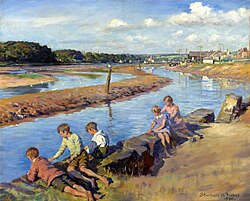
While his outdoor work is celebrated, Forbes was equally adept at interior scenes. In The Lantern (1897), he captured the warm, charming effects of indoor lighting. His ability to empathize with his subjects is perhaps most evident in The Health of the Bride (1889). Mrs. Lionel Birch described this work as a reflection of Forbes's "sympathetic humanity," noting that he depicted humble people in their parlours as real, living beings, understanding the delicate balance between humor and sorrow.
Key Facts
- Primary Style: Specialized in genre scenes and landscapes painted en plein air.
- Key Themes: Sincerity, sympathetic humanity, and the daily lives of working-class people in Cornwall and Brittany.
- Major Accolades: Won the Calcutta Gold Medal for Palmistry (1888) and a Gold Medal at the International Exhibition of Berlin for By Order of the Court.
- Notable Locations: His works are held in prestigious institutions including the Tate Gallery, Victoria and Albert Museum, and Penlee House.
Chronology of Selected Works
Forbes's career spanned several decades, moving from early studies in France to poignant portraits and large-scale murals in London.
| Year | Work Title | Location/Note |
|---|---|---|
| 1881 | A Street in Brittany | Walker Art Gallery, Liverpool |
| 1884-85 | A Fish Sale on a Cornish Beach | Plymouth City Museum and Art Gallery |
| 1888 | The Village Harmonic | Exhibited at Royal Academy |
| 1889 | The Health of the Bride | Purchased by Henry Tate |
| 1901 | The 22nd January 1901 | Royal Albert Memorial Museum, Exeter |
| 1916 | Second Lieutenant Alec Forbes | Duke of Cornwall's Light Infantry Museum |
| 1939 | Robert Cyril Morton Jenkins | Portrait of Chief Constable of Penzance |
| 1899 | The Great Fire of London 1666 | Mural at the Royal Exchange, London |
Legacy and Collections
The influence of Stanhope and Elizabeth Forbes continues through the Forbes Reading Room, established by the West Cornwall Art Archive (WCAA) in Penzance. This resource preserves books and files related to the Forbes's work and their students.
Today, his paintings are distributed globally, appearing in collections across Britain, Australia, and New Zealand. Notable repositories include the Imperial War Museum, the Royal Academy, and the Geelong Art Gallery in Victoria, Australia.
Frequently Asked Questions
What does "en plein air" mean in the context of Forbes's work?
En plein air is a French expression meaning "in the open air." It refers to the practice of painting outdoors to directly observe and capture the natural light and atmosphere of a landscape.
Which of Forbes's works won international awards?
Forbes won the Calcutta Gold Medal for his 1888 painting Palmistry and a Gold Medal at the International Exhibition of Berlin for By Order of the Court.
Where can the public view Stanhope Forbes's paintings today?
His works are held in several museums, including Penlee House, the Tate Gallery, the Victoria and Albert Museum, the Imperial War Museum, and the Royal Cornwall Museum in Truro.
What was the subject matter of Forbes's murals at the Royal Exchange?
In 1899, Forbes painted two murals for the Royal Exchange in London: one depicting The Great Fire of London 1666 and another showing the Destruction of the Second Royal Exchange in 1838.
How did critics describe Forbes's approach to his subjects?
Critics and contemporaries described him as an unsentimental and sincere painter who possessed a sense of "sympathetic humanity," allowing him to connect deeply with the humble people he depicted.