
Trauma Center: Gameplay Mechanics, Settings, and Narrative Themes
The Trauma Center series blends high-stakes medical simulation with a visual novel storytelling style. By combining first-person surgical perspectives with a dramatic narrative, the series places players in the role of surgeons fighting against both natural ailments and man-made biological threats.
Key Facts
- Core Gameplay: Combines first-person surgery simulation with visual novel storytelling.
- Primary Organization: Caduceus, an international body fighting intractable diseases and bioterrorism.
- Signature Ability: The Healing Touch, a superhuman power activated by drawing a star.
- Timeline: Set in a near-future Earth where cancer and AIDS have been cured.
- Recurring Characters: Derek Stiles and Naomi Kimishima.
Surgery Simulation and Gameplay
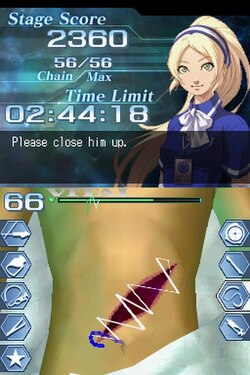
At its core, the series focuses on the precision of surgical operations. Players utilize a wide array of medical tools to treat patients, ranging from standard procedures like tumor extractions and bone fixation to complex organ transplants and the treatment of artificial pathogens. The toolkit includes scalpels, forceps, suture needles, surgical drains, lasers, and ultrasound scanners. To manage patient health, surgeons use a specialized antibiotic gel for healing and syringes to administer vital stabilizers and medicines.
Beyond standard tools, players may use a defibrillator for resuscitation and bandages to close incisions. While the Nintendo DS titles relied on touch-screen icons, later entries like Second Opinion, New Blood, and Trauma Team integrated Wii Remote and Nunchuk motion controls to enhance the experience.
Expanded Medical Specialties
While surgery is the primary focus, Trauma Team expands the scope of medical practice to include five additional specialties:
- Emergency Medicine: Providing rapid treatment to patients at the scene of an incident.
- Endoscopy: Performing small-scale internal treatments within the gastrointestinal (GI) and respiratory tracts.
- Orthopedics: Focusing on skeletal reconstruction and operations.
- Diagnosis: Determining medical conditions through patient interviews and scan examinations.
- Forensic Medicine: Analyzing victims and crime scene evidence to solve cases.
The Healing Touch
A defining element of the series is the Healing Touch, a superhuman ability granted to select surgeons. Activated by drawing a star on the screen, this power allows surgeons to perform feats such as slowing down time, healing patients instantly, or stabilizing dropping vitals. While central to most titles, these fantastical elements were significantly reduced or removed in Trauma Team.
Setting and World-Building
The series takes place in a near-future version of Earth where medical science has advanced enough to cure previously terminal illnesses like cancer and AIDS. Much of the action centers around Caduceus, an international organization that evolved from a secret U.S. Department of Health and Human Services body. While publicly known for researching intractable diseases, Caduceus operates semi-covertly to combat bioterrorism and artificial pathogens across its branches in Japan, Europe, and the United States.
The narrative often unfolds around Resurgam First Care, a fictional American hospital. The timeline spans several years, beginning in 2018 with the original game and its remake, followed by Under the Knife 2 three years later, and New Blood ten years after Second Opinion. Trauma Team occurs after Second Opinion but remains loosely connected to the broader series plot.
| Title | Timeline Setting | Key Narrative Focus |
|---|---|---|
| Original / Remake | 2018 | Foundational surgical combat |
| Under the Knife 2 | 3 years after original | Doctor shortages and human enhancement |
| Second Opinion | Pre-New Blood | Limits of medical technology |
| New Blood | 10 years after Second Opinion | Healthcare costs and medical inequality |
| Trauma Team | Post-Second Opinion | Preciousness of life and fear of death |
Narrative Themes
The series consistently explores the passion of medical professionals and the societal impact of bioterrorism. Different titles delve into specific ethical and social dilemmas:
- Medical Ethics: New Blood examines the inequality of medical access and the rising costs of healthcare.
- Professional Challenges: Under the Knife 2 addresses the pressures of medical training and physician shortages.
- Humanity: Trauma Team, inspired by the 2009 swine flu pandemic, focuses on the fear of death and the value of human life.
Frequently Asked Questions
What is the Healing Touch?
The Healing Touch is a superhuman ability available to certain surgeons in the series. It is activated by drawing a star on the screen and allows the user to manipulate time or stabilize a patient's vitals.
What is the role of Caduceus?
Caduceus is an international medical research organization that publicly studies intractable diseases while secretly fighting bioterrorism and artificial pathogens.
How does Trauma Team differ from other games in the series?
Trauma Team introduces five non-surgical specialties (such as forensics and diagnosis) and tones down the science fiction elements, including the removal of the Healing Touch.
Who are the recurring characters in the series?
Derek Stiles appears in every title in the series, and Naomi Kimishima is a key character in both Second Opinion and Trauma Team.
What platforms influenced the gameplay controls?
The DS titles utilized the touch screen for tool selection, while the Wii versions (Second Opinion, New Blood, and Trauma Team) implemented motion controls via the Wii Remote and Nunchuk.