
Tripoli After the Ottoman Conquest: Governance, Conflict, and the Struggle for Control
The fall of Tripoli marked a pivotal shift in the geopolitical landscape of the 16th-century Mediterranean. Following the city's capture, the Ottoman Empire sought to transform the region into a strategic bastion of power in North Africa. This transition was marked by internal political friction, massive infrastructural upgrades, and a series of violent clashes between the Ottomans and the Order of St. John, also known as the Hospitallers.
The Governance of Ottoman Tripoli
Immediately following the city's capture, Sinan Pasha appointed Murad Agha as the beylerbey (a high-ranking provincial governor). Murad Agha focused on consolidating Ottoman authority, improving the city's fortifications, and establishing a fortified mosque at Tajura.
However, this appointment created tension with Dragut, a prominent Ottoman commander who had been promised the governorship. In protest, Dragut left North Africa for the Tyrrhenian Sea and eventually Constantinople, supported by Ottoman crews who refused to serve under any other leader. To resolve the conflict, Sultan Suleiman offered Dragut the governorship of Karlieli and ordered Sinan Pasha to follow Dragut's directives.
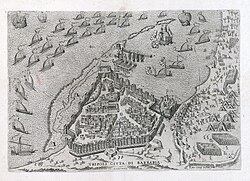
By 1553–1554, Dragut finally assumed the role of beylerbey of Tripoli. His tenure transformed the city into one of the most formidable strongholds in Africa. He constructed a new fortress and commissioned various civic buildings, including the conversion of the main Hospitaller church into the Sidi Darghut Mosque around 1560.
Under Dragut's leadership, Tripoli became a primary base for the Barbary corsairs—state-sponsored privateers who conducted raids across the Mediterranean. A notable example of this power was the 1558 sack of Reggio, where most of the town's population was enslaved and transported back to Tripoli. Dragut ruled until 1565, when he died during the Great Siege of Malta.
European Reactions and Political Fallout
The loss of Tripoli sent shockwaves through European courts. D'Aramont and de Nicolay, who returned to Malta on August 23, were met with hostility and accusations of treason by the Hospitallers. D'Aramont's relationship with the Ottomans—including his participation in the victory banquet—led Emperor Charles V and Pope Julius III to suspect that France had actively encouraged the Ottoman conquest.
While the French King Henry II eventually secured the dismissal of charges against d'Aramont, the Hospitallers still sought scapegoats for the disaster. Grand Master Homedes targeted de Vallier and Galatian de Sesse, the former Governor of Gozo. Despite the defense provided by Nicolas Durand de Villegaignon, who blamed Homedes' own negligence and greed, de Vallier and three other knights were stripped of their habit and cross.
The fall of Tripoli served as a catalyst for the broader Italian War of 1551–1559. Fearing a subsequent attack on Malta in 1552, the Pope urged Homedes to move his headquarters to Sicily. In response, the Hospitallers began expanding Malta's fortifications to prevent a similar fate to that of Tripoli.
Failed Attempts to Recapture the City
The Hospitallers did not accept the loss of Tripoli without a fight. In 1552, they launched a raid on the hinterland and sacked the town of Zuwarah, though they were eventually repelled by a counterattack led by Murad Agha.
The desire to retake the city persisted under Grand Master de Valette, elected in 1557. In 1559, following the attack on Reggio, a coalition of Christian states assembled a massive invasion force in Messina. The fleet sailed for Tripoli in February 1560, but disease and severe weather prevented a direct assault on the city.
Instead, the coalition captured the island of Djerba. This victory was short-lived; in May 1560, an Ottoman fleet commanded by Piali Pasha and Dragut crushed the Christian forces at the Battle of Djerba. By July 1560, the remaining Spanish garrison surrendered, marking the end of Christian efforts to reclaim Tripoli.
Key Facts
- Ottoman Rule: Tripoli remained under Ottoman control (direct or indirect) from the mid-16th century until 1911, when it was captured by Italy.
- Military Stronghold: Under Dragut, Tripoli became one of Africa's best-defended cities.
- Religious Transition: The main Hospitaller church was converted into the Sidi Darghut Mosque around 1560.
- The Battle of Djerba (1560): This decisive Ottoman victory ended the final Christian attempt to retake Tripoli.
- Strategic Impact: The siege of Tripoli was the opening phase of the Italian War of 1551–1559.
| Year | Event | Key Figure(s) |
|---|---|---|
| Post-Capture | Appointment of Murad Agha as beylerbey | Sinan Pasha, Murad Agha |
| 1553–1554 | Dragut becomes beylerbey of Tripoli | Dragut |
| 1558 | Sack of Reggio | Barbary Corsairs |
| 1560 | Battle of Djerba | Piali Pasha, Dragut |
| 1655 | Death of Dragut at the Great Siege of Malta | Dragut |
| 1911 | Capture of Tripoli by Italy | Italy |
Frequently Asked Questions
Who was the most influential Ottoman governor of Tripoli?
Dragut was the most influential governor. He strengthened the city's defenses, making it one of the best-defended cities in Africa, and established it as a major base for the Barbary corsairs.
How did the Hospitallers react to the loss of the city?
The Hospitallers reacted with internal conflict, accusing diplomats like d'Aramont of treason and stripping several knights of their rank to find scapegoats for the defeat.
What was the significance of the Battle of Djerba?
The Battle of Djerba in 1560 was the final failed attempt by a Christian coalition to recapture Tripoli, effectively securing Ottoman control over the region.
What happened to the Hospitaller church in Tripoli?
Around 1560, the main church used by the Hospitallers was converted into the Sidi Darghut Mosque by Dragut.
When did Ottoman rule over Tripoli finally end?
Ottoman rule ended in 1911 during the Italo-Turkish War, when the city was captured by Italy.