
Winter Service Equipment: Specialized Machinery for Snow and Ice Control
Maintaining safe transportation networks during winter requires a sophisticated array of machinery designed to combat ice and snow. From ensuring aircraft can safely take off to keeping highways open for commuters, winter service equipment employs a variety of chemical and mechanical methods to manage frozen precipitation. These tools range from massive snow melters to precision friction testers, each serving a specific role in the ecosystem of winter road maintenance.
Key Facts
- De-icers use propylene glycol to prevent ice formation on aircraft and roads.
- Gritters utilize freezing-point depression to melt ice using rock salt or specialized chemicals like potassium acetate for airports.
- Snow blowers can remove over 5,000 tonnes of snow per hour, far exceeding the capacity of standard plows.
- Snow melters eliminate the need to transport snow by turning it into water on-site using powerful burners.
- Surface friction testers use a specialized fifth wheel to measure road slipperiness and optimize vehicle deployment.
Chemical Ice Control: De-icers and Gritters
De-icing Vehicles
De-icers apply heated fluids—most commonly propylene glycol (which replaced the formerly used ethylene glycol)—to aircraft bodies and road surfaces. For aircraft, removing ice is critical because ice roughens the wing surface, which reduces lift, increases drag, adds weight, and disrupts the aircraft's balance. Aircraft de-icing trucks typically feature a large tanker for concentrated fluid, a water feed for temperature-based dilution, and a cherry picker crane. This setup allows a single vehicle to treat a Boeing 737 in under 10 minutes.
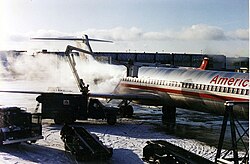
On roads, brine (a salt-water solution) is used as an anti-icer. Sprayed before or during a storm, brine prevents snow and ice from adhering to the pavement, making mechanical plowing easier. Brine is more environmentally friendly than solid salt and acts faster because it does not require the compression of passing traffic to become effective.
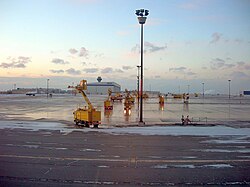
Gritters and Salt Spreaders
A gritter, also known as a sander or salt truck, spreads grit—usually rock salt—onto roads. The salt is stored in a rear hopper and distributed via a hydraulic impeller. Salt works through freezing-point depression, lowering the temperature at which ice melts. Sand is added to increase friction between tires and the road.
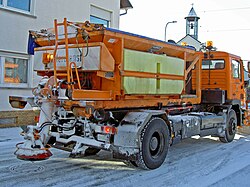
Salt application rates vary by road condition: approximately 10 g/m² for light ice and up to 40 g/m² for thick snow. Because standard road salt can corrode aircraft airframes and interfere with navigation equipment, airport gritters use safer alternatives such as potassium acetate or urea.
Mechanical Snow Removal
Snowplows and Front-End Loaders
Snowplows are the primary tool for clearing blocked roads. Most are mounted on hydraulically actuated arms that allow the blade to be raised, lowered, and angled. Some vehicles are "all purpose," combining a plow frame with a gritting body. In smaller areas like parking lots or sidewalks, front-end loaders are used. These may use a bucket or snowbasket to load snow into dump trucks.
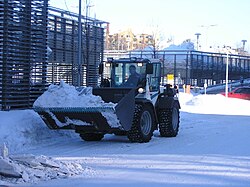
Snow Blowers and Jet-Powered Systems
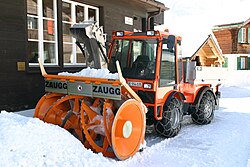
Snow blowers use a rapidly spinning auger to cut through snow and force it through a funnel. They are faster than plows and can handle deeper drifts, removing snow from the roadway entirely rather than pushing it to the side. Some specialized railroad systems use jet-powered blowers. These machines use high-velocity air and exhaust temperatures exceeding 1,000°F (538°C) to melt and clear recalcitrant precipitation from tracks.
Snow Sweepers
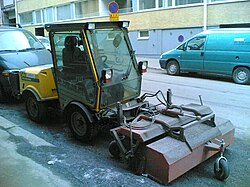
For thin layers of snow (below 10 cm), snow sweepers use flexible brushes. These are ideal for airport runways, racing tracks, and tactile tiles at tram stops because they follow the terrain without damaging the surface. Jet sweepers enhance this process by adding an air-blower behind the brushes to prevent loosened snow from settling.
Specialized Maintenance and Testing
Snow Groomers
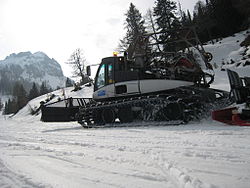
Unlike removal equipment, snow groomers smooth and compact snow. While once simple rollers hauled by oxen, modern groomers use advanced electronics to create specific terrains, such as half-pipes for snowboarding. However, the heavy pressure from these vehicles can increase soil infiltration rates and decrease field capacity, making the ground more prone to erosion.
Snow Melters
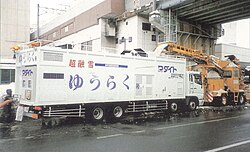
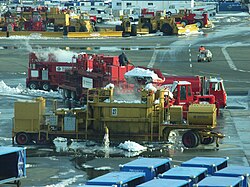
Snow melters scoop snow into a tank where it is instantly melted by a jacket of warm water heated by a powerful burner. While they have a lower capacity than blowers (500 metric tons per hour versus 5,000), they eliminate transportation costs and allow pollutants to be separated from the meltwater before discharge.
Surface Friction Testers
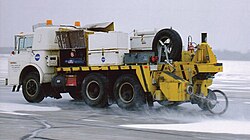
To optimize the deployment of winter fleets, surface friction testers measure road slipperiness. A small fifth wheel is attached to a lightweight vehicle; as it partially slides, sensors measure the torque to calculate friction. Some testers include water sprayers to simulate rain, providing data that helps control centers plan gritting and clearing operations.
Equipment Comparison Summary
| Equipment | Primary Method | Best Use Case | Key Advantage |
|---|---|---|---|
| De-icer | Chemical (Glycol/Brine) | Aircraft & Road Surfaces | Prevents ice bonding |
| Gritter | Chemical (Salt/Acetate) | Highways & Runways | Lowers freezing point |
| Snow Blower | Mechanical (Auger) | Deep drifts/High volume | Complete snow removal |
| Snowplow | Mechanical (Blade) | General road clearing | Efficient for bulk movement |
| Snow Melter | Thermal (Burner) | Urban areas/Polluted snow | No transport required |
| Snow Sweeper | Mechanical (Brushes) | Runways & Tactile tiles | Non-compressive cleaning |
Frequently Asked Questions
Why can't standard road salt be used on airport runways?
Standard road salt can damage the airframes of aircraft and interfere with sensitive navigation equipment. Airports instead use potassium acetate or urea, which are non-corrosive to airside equipment.
What is the difference between a de-icer and an anti-icer?
A de-icer removes ice that has already formed, while an anti-icer (like brine) is applied before or during a storm to prevent snow and ice from adhering to the surface in the first place.
How does a surface friction tester work?
It uses a small, freely rolling fifth wheel that is slightly turned to create a partial slide. Sensors measure the torque produced by this rotation to calculate the friction between the wheel and the pavement.
Why are snow blowers preferred over plows in some scenarios?
Snow blowers can move much larger volumes of snow (up to 5,000 tonnes per hour) and remove it from the roadway entirely, preventing the creation of windrows that block driveways or obstruct other road users.
What are the environmental impacts of snow groomers?
Regular pressure from grooming vehicles increases the soil's infiltration rate and decreases its field capacity, which can lead to increased soil erosion within ski resorts.