
Nassau County Bus History: From Private Lines to NICE
The evolution of public transportation in Nassau County is a story of transition—from a fragmented network of private operators to a centralized public authority, and eventually to a public-private partnership. For decades, the region has struggled to balance the rising costs of labor and materials with the necessity of providing reliable transit for thousands of daily commuters.
The Era of Private Companies (Pre-1973)
In the mid-1960s, Nassau County's transit landscape was composed of 17 private bus companies operating under county-granted franchises. By the late 1960s, the instability of these private ventures became apparent. In 1970, the New York State Public Service Commission (PSC) had to reorganize routes after Semke Bus Lines and Mid Island Transit ceased operations following a denied request to increase fares from 20 to 35 cents.
Financial pressures mounted throughout the early 1970s. Private operators cited increasing labor costs and fierce competition from private automobiles. By 1972, companies like Schenck Transportation proposed significant fare hikes and the elimination of evening and weekend services to offset losses. This instability prompted County Executive Ralph G. Caso to push for a public takeover to ensure service continuity and better coordination with the Long Island Rail Road (LIRR)—the primary commuter rail system serving the region.
On December 27, 1972, the Metropolitan Transportation Authority (MTA) and Nassau County announced the creation of the Metropolitan Suburban Bus Authority (MSBA), a subsidiary designed to consolidate the 10 remaining private companies under one public umbrella.
The Rise of MTA Long Island Bus
The MSBA officially commenced operations in June 1973. This transition allowed for the immediate acquisition of 50 new buses and a revised fare structure intended to make transit more affordable and efficient. Throughout the 1970s and 80s, the agency focused on expanding its reach and improving connectivity.
Key expansions included extending routes to the Plainview County Complex and creating new north-south corridors to serve the Mid-Island Plaza. In 1978, the MTA sought funding to establish four major transfer centers at the Mineola, Lynbrook, Rockville Centre, and Freeport LIRR stations to streamline the commute between buses and trains.
Infrastructure and Service Growth
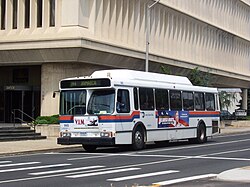
The 1980s marked a period of significant modernization. In 1981, a $23.5 million bus depot was planned for Mitchel Field to centralize maintenance. The agency also tailored its services to support education and industry, extending routes to serve the New York Institute of Technology, SUNY-Old Westbury, and various industrial parks in the eastern and central parts of the county.
By 1994, as part of a broader rebranding effort, the agency was renamed MTA Long Island Bus. The system continued to adapt, introducing specialized shuttles for Roosevelt Field and JFK Airport, and utilizing federal funding through the Job Access Reverse Commute (JARC) program in 2003 to improve service to Hempstead.
Privatization and the Transition to NICE
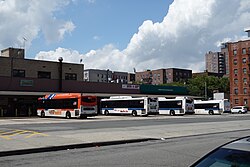
Despite its growth, the system faced a financial crisis by 2011. The MTA proposed drastic service reductions—potentially eliminating 27 of 48 routes—citing Nassau County's failure to meet its contracted payment obligations. This threatened to leave large portions of southeastern Nassau County without bus service.
In response, County Executive Ed Mangano sought to privatize the system. On January 1, 2012, Veolia Transport took over operations through a public-private partnership. The service was rebranded as Nassau Inter-County Express (NICE), featuring a new paint scheme for all vehicles, including Able-Ride paratransit services.
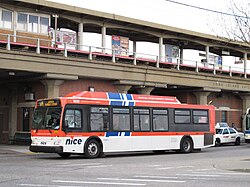
The transition to NICE was not without controversy, facing criticism from employees and riders during public hearings. The subsequent years were marked by ongoing budget deficits and fluctuations in state and county aid, highlighting the perennial challenge of funding public transit in the suburbs.
Key Facts
- Pre-1973: 17 private companies originally served Nassau County.
- 1973: The Metropolitan Suburban Bus Authority (MSBA) was formed to publicize transit.
- 1994: The system was rebranded as MTA Long Island Bus.
- 2012: Operations transitioned to a private partnership under the name NICE (Nassau Inter-County Express).
- Ridership: Weekday ridership averaged over 109,000 in 2007 and approximately 101,981 by 2011.
| Era | Operator Type | Primary Agency/Entity | Key Characteristic |
|---|---|---|---|
| Pre-1973 | Private | Various (e.g., Hempstead Bus Corp) | Fragmented, franchise-based |
| 1973–2011 | Public | MTA Long Island Bus (MSBA) | Centralized, LIRR integration |
| 2012–Present | Public-Private | NICE (operated by Veolia) | Privatized management |
Frequently Asked Questions
Why did Nassau County move from private bus companies to the MTA?
The transition occurred because private operators faced unsustainable costs and competition from cars, leading to proposed service cuts and fare hikes that the county wanted to avoid to ensure stable public transit.
What is the difference between MSBA and MTA Long Island Bus?
They are the same entity; the Metropolitan Suburban Bus Authority (MSBA) was the original name used upon the 1973 takeover, which was later changed to MTA Long Island Bus in 1994 during an MTA rebranding.
What led to the creation of the NICE bus system?
NICE was created in 2012 after a funding dispute between the MTA and Nassau County led the MTA to propose massive service cuts, prompting the county to privatize operations via a contract with Veolia Transport.
How did the bus system integrate with the LIRR?
The system focused on creating "feeder" routes that brought passengers to LIRR stations and established dedicated transfer centers in Mineola, Lynbrook, Rockville Centre, and Freeport.
What was the impact of the 2011 service cut proposals?
The MTA proposed eliminating 27 of 48 routes, which would have affected roughly 15% of ridership and completely removed service from areas south of Hempstead Turnpike and east of the Meadowbrook State Parkway (except for the N71).