
Paper Cup History: From Ancient China to the Modern Dixie Cup
The humble paper cup is a staple of modern convenience, yet its origins span millennia and a critical shift in global public health. While we now view disposable cups as a standard part of daily life, their rise was driven by a desperate need to curb the spread of germs in public spaces.
Ancient Origins in Imperial China
Long before the industrial revolution, paper cups were utilized in imperial China, the birthplace of paper invention by the 2nd century BC. Known as chih pei, these early vessels were specifically used for serving tea. They were not merely functional; they were produced in various sizes and colors and often featured intricate decorative designs.
Historical records, including descriptions of the possessions of the Yu family from the city of Hangzhou, provide textual evidence of the use and prevalence of these early paper cups.
The Public Health Crisis of the Early 20th Century
By the early 1900s, drinking water in the United States was often accessed via shared glasses or dippers located at school faucets and train water barrels. This practice created significant public health concerns regarding the transmission of disease.
A pivotal moment occurred in August 1908, when Alvin Davison, a biology professor at Lafayette College, published a study in Technical World Magazine titled "Death in School Drinking Cups." Based on research conducted in the public schools of Easton, Pennsylvania, the study highlighted the dangers of shared cups. The findings were so impactful that the Massachusetts State Board of Health reprinted and distributed the article in November 1909.
The Rise of the Dixie Cup
In response to these sanitary concerns, Lawrence Luellen, a Boston-based inventor, sought a solution in 1907. Luellen developed an ice-cooled water-vending machine that dispensed disposable cups, eliminating the need for shared glassware. Partnering with Hugh Moore, Luellen launched an advertising campaign to market these machines, primarily targeting American railroad companies.
The timing was ideal. As local bans on shared-use cups were passed across the USA, the demand for clean, cheap paper goods surged. The Lackawanna Railroad became one of the first to adopt disposable cups in 1909. By 1917, public glasses had virtually disappeared from American railway carriages.
Corporate Evolution and Branding
Luellen's entrepreneurial efforts led to the creation of several entities, starting with the American Water Supply Company of New England in 1908. To expand, he and Moore established subsidiary companies in New York and New Jersey to handle sales and distribution. In 1909, they formed the Public Cup Vendor Company to lease vending machines to railroads.
By 1910, these ventures merged into the Individual Drinking Cup Company of New York. Originally branded as the "Health Kup," the product was renamed in 1919 after the Dixie Doll Company, a line of dolls created by Alfred Schindler. This led to the official formation of the Dixie Cup Corporation.
Expansion and Industrial Legacy
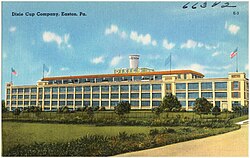
The company eventually moved its operations to a factory in Wilson, Pennsylvania, which famously featured a large cup-shaped water tank on its roof (removed on April 30, 2026). Over the decades, the company underwent several corporate transitions:
- 1957: Dixie merged with the American Can Company.
- 1982: The James River Corporation purchased the paper business from American Can.
- Present: Assets are now part of Georgia-Pacific, a subsidiary of Koch Industries.
In 1983, production shifted to a modern facility in Forks, Pennsylvania, leaving the original Wilson factory vacant and leading to the abandonment of the Easton & Northern railroad branch.
Medical and Mathematical Influence
Beyond public transit, paper cups became essential in healthcare. A 1942 study by Massachusetts State College revealed that using washable glasses—even when sanitized—was 1.6 times more expensive than using single-service paper cups. This cost-efficiency, combined with a reduced risk of cross-infection, solidified their use in American hospitals.
Interestingly, the brand's cultural impact extended to mathematics. The "Dixie cup problem" is a variation of the coupon collector's problem, named after children who traded cups to collect complete sets of pictures featuring movie stars or baseball players.
Key Facts
- Ancient Roots: Paper cups (chih pei) were used for tea in imperial China as early as the 2nd century BC.
- Health Catalyst: Professor Alvin Davison's 1908 study "Death in School Drinking Cups" helped end the use of shared public glasses.
- Innovation: Lawrence Luellen invented the disposable cup and water-vending machine in 1907.
- Railroad Adoption: The Lackawanna Railroad was an early adopter in 1909; by 1917, public glasses were gone from US trains.
- Hospital Efficiency: A 1942 study found paper cups were significantly cheaper than sanitizing reusable glass.
- Design: The iconic Dixie Cup logo was created by graphic designer Saul Bass in 1969.
| Year | Milestone / Event | Key Entity/Person |
|---|---|---|
| 1907 | Invention of disposable cup and vending machine | Lawrence Luellen |
| 1908 | Founding of American Water Supply Company of New England | Lawrence Luellen |
| 1910 | Incorporation as Individual Drinking Cup Company of NY | Luellen & Moore |
| 1919 | Rebranded as Dixie Cup | Dixie Cup Corporation |
| 1957 | Merger with American Can Company | Dixie / American Can |
| 1982 | Acquisition by James River Corporation | James River Corp |
Frequently Asked Questions
Where did paper cups originate?
Paper cups originated in imperial China, where they were known as chih pei and used for serving tea starting around the 2nd century BC.
Why were disposable cups introduced in the United States?
They were introduced to solve public health crises caused by shared drinking glasses at water barrels and faucets, which were found to spread germs and disease.
Who invented the modern Dixie Cup?
Lawrence Luellen, an inventor from Boston, developed the disposable cup and a corresponding ice-cooled water-vending machine in 1907.
Why are paper cups used in hospitals?
They are used to reduce the risk of cross-infection and because they are more cost-effective than the process of sanitizing and reusing glass cups.
What is the "Dixie cup problem" in mathematics?
It is a generalization of the coupon collector's problem, inspired by children trading Dixie cups to complete sets of collectible images.